
M&A Market Update
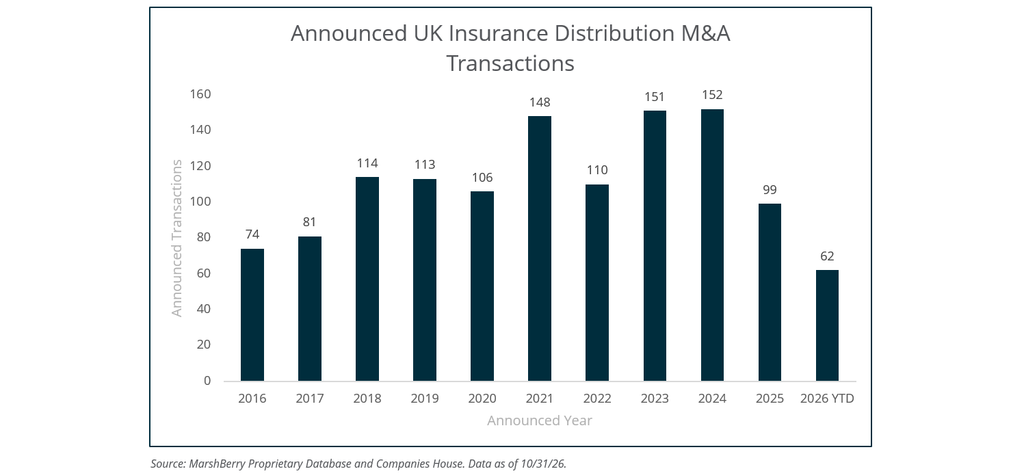
There were only two new deals announced in October, jointly the lowest monthly count over the past ten years. The last time there were only two UK deals announced in a month was in 2017. On a year-to-date (YTD) basis there have been 62 announced merger and acquisition (M&A) transactions in UK insurance distribution, 29% lower than the 87 transactions announced at the same point last year, which was itself a ‘slow’ year for M&A. Deal volumes have continued to slow in 2026 and a large number of the most historically active acquirers have either announced no new UK M&A during 2026 (Howden, PIB Group, Ardonagh, DR&P), or a reduced number of deals relative to the recent past (Gallagher, Brown & Brown, Specialist Risk Group, JMG Group). As MarshBerry noted last month, M&A deal value is up overall in 2026 (mainly due to the McGill & Partners transaction), but on deal count basis 2026 will now certainly end on a multi-year low and well behind 2025.
Well this is a bit embarrassing…
Over the past couple of months we have been remarking here that October 2026 had the potential to see a mini-spike in sector M&A volumes, based on a fear that the Chancellor might again raise the rate of Capital Gains Tax (CGT) in the budget on the 28th of the month. There had been rumours and press commentary swirling for several weeks suggesting that CGT could rise, possibly even to a level that might bring it in line with income tax. As in the recent past (March 2021, October 2024), this sort of uncertainty invariably has the effect of unnerving private sellers and can catalyse M&A activity, as owners rush to complete deals before the budget date.
In the end, fears were unfounded. The headline rate of CGT has not been touched. There has been a reduction in the lifetime limit of Business Asset Disposal Relief (BADR) available to sellers (from £1m to £500k), which will cost a qualifying seller with shares worth £1m or more up to £70k in extra tax when they sell, but this will only come into effect from April 2027. A newly announced Founders’ Relief offering a 10% CGT rate on qualifying disposals also becomes effective from April 2027, but is very unlikely to be relevant to many owners of UK brokers or managing general agents (MGAs), given the various qualifying criteria around ownership, growth and scale.
Furthermore, the fact that CGT had been largely spared was not a surprise when the chancellor sat back down on the 28th. As has become customary, leaks and briefings from the Treasury had squashed speculation in the days leading up to the budget. Any seller racing to sign by the end of October had the pressure removed. There was no spike in activity. Deals that announce over the course of the coming weeks and months may well have been aiming to complete in October, but can now take longer to finalise. The change in BADR noted above means that April 2027 may now be a target date for some sellers.
So there was no spike in deal announcements. Indeed there were only two – the lowest monthly total for years. But new deals that announce over the next few weeks and months may well have been transactions that had previously been aiming for an October completion, until it became clear that the risk of an increased tax rate had been removed.
The continuing demand for specialty
The two new deals announced in October both involved Lloyd’s brokers, and in both cases the acquirer was a private equity-backed (PE) consolidator whose core business is UK commercial broking. A major M&A theme throughout 2026 has been the continuing demand for specialty (MGA and wholesale, including Lloyd’s), with buyers this year coming from PE directly (e.g., EQT, Cinven, FTV Capital), overseas acquirers (DOXA, Bishop Street), and from domestic broking consolidators. Clear, Seventeen and Partners& have all acquired Lloyd’s brokers in 2026.
More than 30% of M&A volume on a YTD basis has involved a specialty target, higher than in any previous year. These specialty businesses often have superior growth to general commercial brokers, as well as high margins, albeit with a different risk profile (in many cases including the lower renewal retention that is natural in wholesaling, higher key man dependency, exposure to volatile risk classes / rate movements, and greater carrier concentration). Commercial brokers have also been attracted by the diversification they offer, an increased exposure to international business (without having to actually set up anything overseas), placement synergies, and ability to offer existing clients a broader range of solutions and coverage for complex risks.

This level of demand shows no signs of abating. As often highlighted in these newsletters, in commercial broking there has long-been a mismatch between demand and supply, with the number of independent brokers being lost to M&A by consolidators outstripping the number of new company formations. This dynamic however is less clear-cut in the specialty sector, as although the total number of UK insurance distribution firms employing ten or more staff that fall under our specification of specialty is just under 25% of all groups, their numbers have actually crept up over the past couple of years, in spite of increased deal activity.
The level of new business startups, proportional to the overall population of insurance distribution firms, has been greater on the specialty side, mainly through MGA numbers. There is a steady stream of teams and individuals spinning out of larger groups, often supported by incubators the various services businesses that can help facilitate day one setup. With the right focus, expertise, data and technology, nimble and responsive firms can often greatly outpace larger carriers and grow quickly. The specialty segment of the market, in spite of its increased proportion of M&A in recent years, is still closer to an equilibrium in terms of firm numbers than commercial broking, where organic growth is difficult (one corollary of very high renewal retention is that winning business to grow a book from a standing start is tough!) and new business formation and scaling, despite encouraging activity at the smaller end – mainly via the AR route – has consistently run well below the number of firms that consolidators take out through M&A each quarter. There are strong arguments to support the idea that the current split of M&A between retail and specialty business is not a blip, but reflects a longer-term shift in the market.
Notable transactions (October 2026*):
- In a further build out of its Lloyd’s and wholesale capability, Clear Group announced that it had acquired specialist broker Commercial Risks (UK), along with its MGA Troon Underwriting, to support the placement of complex and difficult risks into Lloyd’s and company markets. Commercial Risks (UK) is a Lloyd’s broker and coverholder. MarshBerry advised Commercial Risks (UK).
- Seventeen Group, which took on private equity investment in 2025 and has been amongst the most active UK buyers in 2026, announced the acquisition of Dashwood Brewer and Phipps, the storied Lloyd’s broker, heavily building out Seventeen’s London market capability and growing the group’s international reach, in a move that mirrors several of the other commercial broking consolidators’ recent push into Lloyd’s. This also further reduces the number of standalone independent Lloyd’s brokers available.