
High-growth brokerages take a disciplined approach to producer productivity. They align compensation, client segmentation and operating models to maximize profitability. By establishing minimum account thresholds and creating specialized Small Business Units (SBUs), firms can improve producer effectiveness, increase profitability and build more sustainable growth.
Every client relationship has value. However, not every account contributes equally to a brokerage’s profitability. Most insurance brokerages follow the 80/20 principle, where approximately 80% of revenue is generated by just 20% of clients. Conversely, the majority of accounts may consume significant service resources while producing only a small percentage of total revenue.
As firms pursue sustainable organic growth, leaders are increasingly recognizing that producers should spend their time where they create the greatest enterprise value: developing larger, more profitable client relationships. Minimum account thresholds and dedicated SBUs provide the structure to achieve this.
A Small Business Unit can improve profitability
One concern surrounding minimum account thresholds is how smaller clients will continue receiving quality service, and a dedicated SBU can address this. Rather than viewing an SBU solely as a service solution, leading brokerages increasingly recognize it as a profitability engine. An SBU is specifically designed to serve smaller commercial accounts through standardized processes, specialized staff and technology-enabled workflows that lower servicing costs while maintaining strong client relationships.
An SBU is generally more effective for brokerages that have achieved sufficient scale to generate meaningful operating efficiencies and improve profitability. For smaller firms, the benefits may not yet outweigh the additional organizational complexity. However, fast-growing firms should plan proactively for an SBU as they scale, ensuring the appropriate structure is in place as account volume and service demands increase.
For a typical insurance brokerage, servicing a small business account can be expensive and time consuming. Studies show that they typically range from $25-$100 per client interaction. Depending on account size and service frequency, these costs can reduce profitability. Because SBUs are designed around efficiency, standardized processes, and technology-enabled service delivery, they can profitably manage smaller accounts that are often difficult to serve economically under a traditional producer model.
At the same time, producers are relieved of servicing responsibilities that do not fully leverage their skills. They gain capacity to pursue larger prospects, strengthen relationships with key clients and generate higher levels of new business production.
An SBU is generally more effective for brokerages that have achieved sufficient scale to generate meaningful operating efficiencies and improve profitability. For smaller firms, the benefits may not yet outweigh the additional organizational complexity. However, fast-growing firms should plan proactively for an SBU as they scale, ensuring the appropriate structure is in place as account volume and service demands increase.
How firms can get started using an SBU
The first step is to define which clients will be managed through an SBU. Establish clear criteria for this target segment, typically based on factors such as account size, revenue, complexity, and servicing requirements.
Once the target segment is identified, develop a standardized service model. This should include consistent workflows, service standards, renewal processes, and communication protocols that enable smaller accounts to be serviced efficiently while maintaining profitability.
Next, align staffing and technology to support the model. Assign dedicated service professionals, establish appropriate spans of control, and leverage automation and digital tools to reduce producer involvement in routine service activities. This increases operational efficiency and expands capacity.
Finally, start with a pilot program. Launch the SBU with a defined book of business, then track key performance indicators such as client retention, profitability, service capacity, and producer productivity. Use these insights to refine the model before scaling it across the organization.
Create the path to “Risk Advisor” by selling more “complete accounts” up front
Pursuing “complete accounts” can increase a brokerage’s long-term profitability by deepening client relationships and expanding the value delivered to each client. By serving as trusted risk advisors and addressing a broader range of client needs, producers can improve retention, generate additional revenue opportunities, and create more personalized, comprehensive solutions. This approach is more likely to produce sustainable growth and lasting value for both the client and the firm. Here’s how this creates value across the organization:
- Smaller accounts remain profitable through an efficient service model.
- Producers spend more time selling and less time servicing.
- Larger accounts receive increased attention and strategic advisory support.
- Client retention remains strong across all market segments.
- Overall firm profitability improves through better resource allocation.
Optimizing growth with accountability and minimum account thresholds
MarshBerry’s 2026 Insurance Agency & Brokerage Compensation Report shows that many firms pair account thresholds with measurable producer expectations. Rather than treating minimums as suggestions, they integrate them into performance management and compensation programs.
Minimum account thresholds cannot succeed if producer compensation encourages conflicting behaviors. MarshBerry’s Compensation Report shows firms take varying approaches to commissions on accounts below their minimum thresholds. Some continue paying commissions on all business, while others eliminate renewal commissions – or commissions entirely – for accounts below the threshold.
Notably, over 40% of respondents noted that they do not have established minimum annual new business production levels needed to retain renewal percentage in the next year.
However, among the top performing firms (highest 25% in organic growth) that participated in our 2026 compensation study, 66% of them have an annual new business production requirement to maintain renewal compensation the following year.
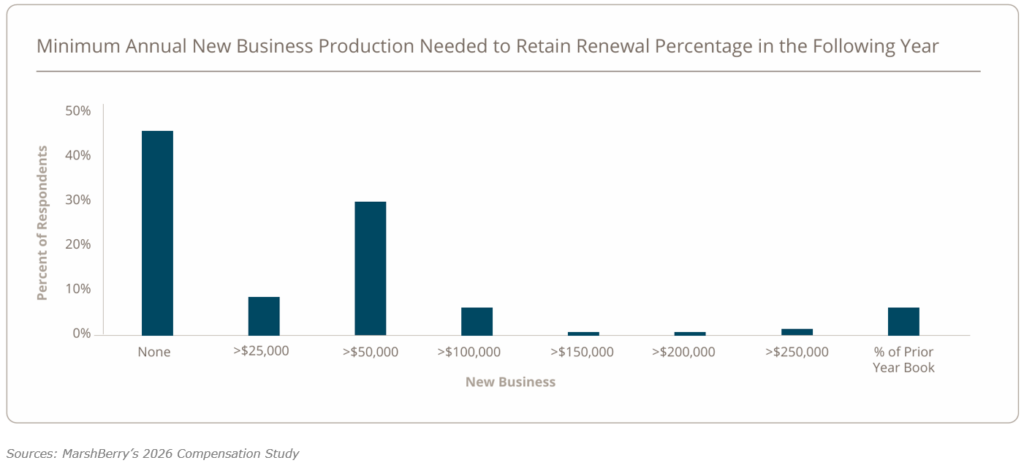
Having new business production requirements can help ensure producers prioritize larger, high-value accounts that contribute to growth. Just as importantly, minimum account thresholds also encourage producers to focus on larger, more profitable client relationships that align with the firm’s strategic objectives. According to MarshBerry data, brokers with a minimum account threshold reported an average organic growth rate of 10.25% – approximately 1.4 percentage points higher than brokers without a minimum account threshold (8.82%).
Firms’ growth goals and minimum account thresholds are linked. Typically, high growth firms double every five years. Using the Rule of 72 (a formula to determine how long it takes to double an investment), this breaks down to 15% growth every year for five years.
Companies striving to grow organically by 15% each year, need to establish a minimum account threshold, and enforce the practice of not compensating producers on renewal commission for these accounts. Finding the right minimum is a balancing act. Too high and you’ll discourage producers and lose volume of small accounts. Too low and producers get stuck in the merry-go-round of hunting small, non-profitable accounts.
Combined with a dedicated SBU, aligned compensation plans, clearly defined producer expectations, account size minimums allow brokers to maximize producer capacity, improve operational efficiency and profitability. Furthermore, establishing strategic account size minimums can help create the discipline necessary to achieve sustainable, profitable growth.
The value of a compensation study
MarshBerry’s comprehensive, one-of-a-kind industry report evaluates compensation trends across multiple roles in insurance brokerage. It provides over 100 charts illustrating respondent data and detailed insights into the results. The report allows insurance brokerages to benchmark where their firm sits in the range of industry peers on compensation approaches. It can reinforce their current approach or reveal areas for change.
As insurance brokerages continue to look for ways to grow their business, whether through their product offerings, service capabilities, or technology upgrades, people will always be at the root of everything they do. Having a top-performing organization with top-performing personnel starts with a top-performing compensation strategy.
Learn more about MarshBerry’s 2026 Insurance Agency & Brokerage Compensation Study.