
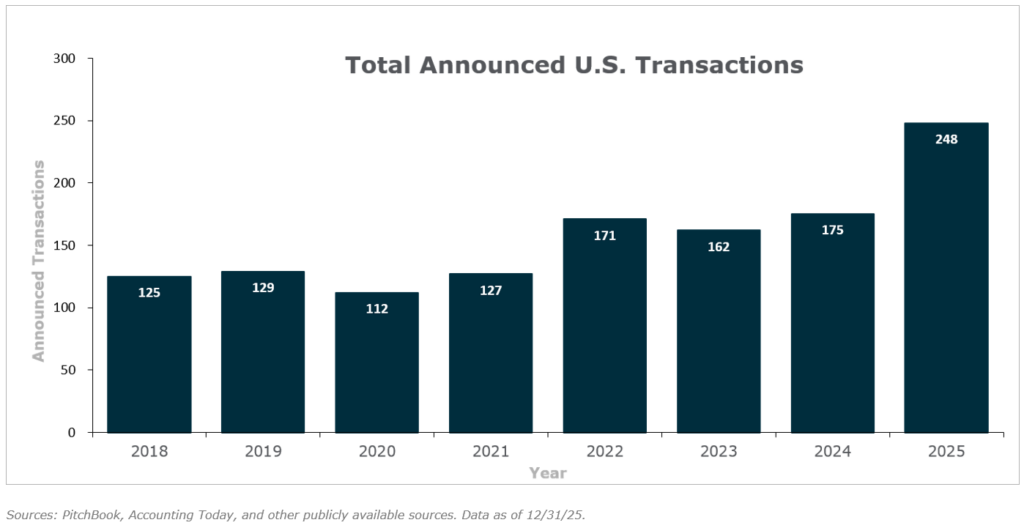
In 2025, U.S. accounting and tax firm mergers and acquisitions (M&A) shifted into a new gear. After several years of relatively steady activity through 2021, industry dealmaking began to increase in 2022 and ultimately reached a new high in 2025, reflecting a market that is no longer driven by one-off local successions. Instead, the data now points to a higher annual run rate of transactions, supported by repeat buyers and an expanding set of firms pursuing scale as a strategic necessity.
Private equity (PE) has been the defining catalyst behind this shift. Since 2018, the share of PE-backed deals has risen from negligible levels to more than 40% of all transactions in 2025, with the sharpest acceleration occurring over the last two years. That change matters because the introduction of private capital is generally not limited to a single deal, rather, it provides strategic program funding: investment in talent and technology, plus the capacity to execute consistent add-on acquisitions. In practical terms, the accounting and tax space is experiencing investments recently seen in other professional services sectors such as wealth management and insurance brokerage that have already moved into sponsor-backed platform building.
The buyer mix in 2025 makes the consolidation story tangible. The top ten acquirers represented roughly 25% of all deals, and nine of those ten were private capital-backed platforms. Names like Ascend Partner Services, Platform Accounting Group, Aprio, Baker Tilly, Doeren Mayhew, Citrin Cooperman, and others are no longer occasional participants. They are emerging as consolidators with repeatable playbooks, using acquisitions to expand geography, broaden service lines, and build deeper operating infrastructure.
M&A market update
As of December 31, 2025, 248 accounting and tax M&A transactions were announced across the U.S., a 41.7% increase from the 175 deals recorded in 2024 and the highest annual total on record.
Private capital-backed buyers were responsible for 103 of those transactions, representing 41.5% of total activity and, notably, marking the first year in which sponsor-backed firms captured a larger share of the market than independent acquirers. Independent firms completed 92 transactions, accounting for 37.1% of overall volume, while wealth management buyers announced 16 transactions during the year. Pure tax firms represented 44 of the announced targets, or 17.7% of total deal activity, underscoring continued interest in specialized service offerings.
Buyer concentration also continued to take shape. Ten acquirers were responsible for 24.6% of all announced transactions in 2025, with the top three buyers (Ascend Partner Services, Platform Accounting Group, and Aprio) representing 10.9% of total volume.
Notable Transactions
- 1/9/25: A Blackstone-led investor group agreed to acquire a majority stake in Citrin Cooperman from New Mountain Capital, valuing the top 20 U.S. accounting firm at approximately $2 billion and marking the first known private equity to private equity transfer of an audit firm. New Mountain initially invested at a reported valuation of roughly $500 million in 2021, implying an approximate 4.0x increase in enterprise value in less than three years. The step-up reflects substantial inorganic expansion during the hold period, as well as continued multiple expansion driven by strong private equity demand for scaled, acquisitive accounting and advisory platforms.
- 4/21/25: Baker Tilly and Moss Adams announced plans to combine in a transaction that will create the sixth largest advisory CPA firm in the U.S., significantly expanding scale across advisory, tax, and assurance services for middle-market clients. As part of the transaction, existing investor Hellman and Friedman will make an additional investment, alongside increased backing from Valeas Capital Partners, reinforcing PE support behind the platform. Following closing, the firms’ audit practices will operate as Baker Tilly US, LLP, while advisory and tax services will combine under Baker Tilly Advisory Group.
- 8/1/25: Wipfli entered into a definitive agreement for a significant minority investment from New Mountain Capital to accelerate growth across its accounting, tax, and advisory platform. The firm, which generates more than $600 million in annual revenue and has completed 34 acquisitions over the past decade, plans to use the capital to expand talent, technology, and strategic M&A while building on its advisory business, which now represents nearly half of total revenue. The investment will be made through New Mountain’s non-control strategic equity strategy, allowing Wipfli to remain majority partner-owned and independently operated.
2026 Outlook
Looking ahead, MarshBerry believes that 2026 will bring further consolidation across the U.S. accounting and tax landscape. The structural drivers behind the recent surge remain intact: aging ownership demographics, increased private capital interest, and the growing need for scale to support technology investment and specialized solution offerings. As more firms evaluate succession and capital options, transaction volume is expected to continue trending upward, supported by both sponsor-backed platforms and increasingly active strategic buyers.
A key dynamic will be trends in valuation as recapitalizations begin to surface across earlier vintages of private capital investment. While premium multiples have defined the upper end of the market in recent years, recap activity may introduce greater dispersion in pricing, particularly in segments where growth or margin expansion has moderated. Any compression at the platform level has downstream implications, as it can influence how aggressively buyers price add-on acquisitions. Even so, well-performing firms with strong organic growth, niche capabilities, and scalable leadership should continue to command attractive valuations.
Importantly, many of today’s most active acquirers are no longer building their playbooks. They have established sourcing pipelines, dedicated integration teams, and refined post-close processes. That institutionalization of M&A creates capacity for higher annual deal counts. As platforms mature and confidence in integration execution increases, expect to see several repeat buyers further accelerate their activity. In our view, 2026 is positioned to reflect not only healthy deal flow, but a more sophisticated and operationally driven approach to growth within accounting and tax.