
The second quarter of 2026 reinforced the strong momentum in U.S. accounting and tax firm mergers and acquisitions (M&A), with consolidation continuing despite broader economic uncertainty. Private equity (PE) remains a primary driver of activity, reshaping acquisition strategies across the accounting and tax sector. This interest reflects the sector’s recurring revenue, resilient client demand, and growing mix of higher-margin advisory services.
PE firms are increasingly using acquisitions to expand specialized capabilities, strengthen talent, and improve long-term competitiveness. Rather than focusing solely on expanding geographic reach, PE buyers are increasingly targeting firms with specialized service offerings that complement existing practices. Recent transactions have strengthened capabilities across areas including outsourced accounting, property tax, valuation, wealth management, and CFO advisory services, reflecting growing client demand for more comprehensive solutions from a single provider.
Talent remains one of the primary drivers of M&A across the accounting and tax industry. Ongoing shortages of experienced CPAs, tax professionals, and firm leaders have made acquisitions an increasingly effective way to strengthen technical expertise, support succession planning, and preserve client relationships. As a result, buyers – particularly sponsor-backed platforms – are placing greater emphasis on the quality of a firm’s people alongside its financial performance when evaluating acquisition opportunities.
Buyers are also placing greater emphasis on firms with specialized accounting and tax capabilities. Demand for outsourced accounting, CFO advisory, state and local tax (SALT), valuation, and wealth advisory services continue to grow, prompting buyers to target firms with differentiated expertise. These acquisitions enable firms to broaden client relationships, cross-sell complementary services, and build more diversified advisory platforms.
Looking ahead, accounting and tax firm M&A is expected to remain supported by strong buyer demand, continued private capital investment, and the need for specialized talent and advisory capabilities. As competition for differentiated firms increases, buyers that successfully integrate acquisitions while expanding advisory expertise will be best positioned for long-term growth.
M&A market update
As of June 30, 2026, there were 108 accounting and tax M&A transactions announced across the U.S., continuing momentum after a record year for deal activity in 2025.
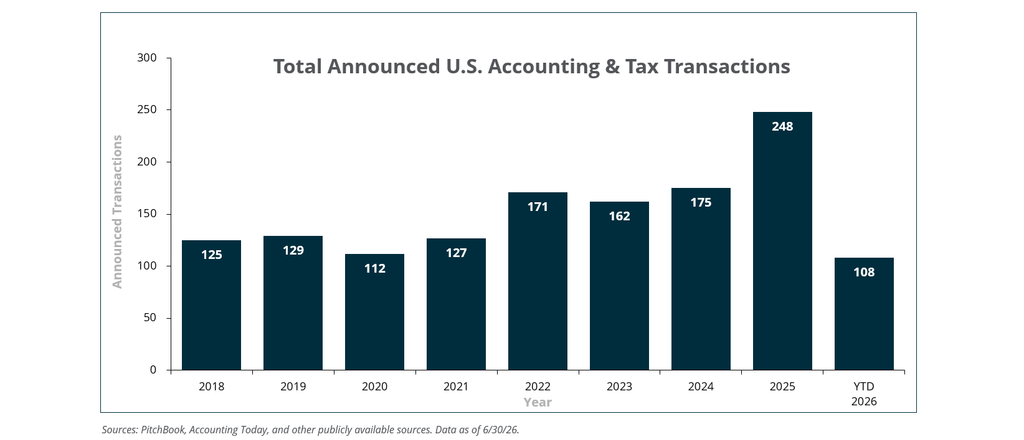
Private capital-backed buyers were responsible for 51 of those transactions through H1 2026, representing 47% of total activity, compared to full year 2025 when they accounted for 41.5% of transactions. Independent firms completed 38 transactions, accounting for 35% of overall volume, while wealth management buyers announced nine transactions during H1 2026. Pure tax firms represented 17 of the announced targets, or 15.7% of total deal activity.
Buyer concentration also continued to take shape. The ten most active acquirers accounted for 26.9% of all announced U.S. transactions YTD 2026. Aprio led the market with five deals, representing 4.6% of total volume, while six buyers tied for second with three transactions each. Institutional capital continues to shape the competitive dynamics and pace of consolidation within the accounting and tax sector.
Notable Transactions
- May 1: Ascend has added Jackson Thornton, a Montgomery, Alabama-based accounting and advisory firm, to its platform. Founded in 1919, Jackson Thornton provides tax, audit, consulting, technology and wealth management services through six offices across Alabama, serving clients in industries including healthcare, construction, manufacturing, government and automotive dealerships. The firm also oversees approximately $2 billion in assets through its wealth management business, giving Ascend additional scale in a differentiated service area. The partnership strengthens Ascend’s presence in the Southeast while expanding its multidisciplinary capabilities and supporting the firm’s continued growth through investments in technology, operational resources and client services.
- June 1: Cherry Bekaert, a national accounting and advisory firm, has acquired Houston-based Calvetti Ferguson, an accounting and advisory practice serving middle-market clients across sectors including real estate, energy, private equity, financial services and technology. The transaction expands Cherry Bekaert’s footprint in Texas with added presence in Houston, Dallas/Fort Worth and San Antonio, while also strengthening its position in the Nashville market. By combining the firms, Cherry Bekaert enhances its industry expertise and regional reach, further supporting its strategy of growing its middle-market client base and expanding its advisory capabilities in key markets.
- June 10: Funds managed by Madison Dearborn Partners (MDP), with participation from Norlantic Capital, have made a strategic growth investment in Stephano Slack, a Pennsylvania-based accounting and advisory firm. Founded in 2004, Stephano Slack provides tax, audit, outsourced accounting and advisory services to middle-market clients and has expanded through a series of acquisitions while earning recognition as one of the fastest-growing accounting firms in the U.S. The investment is expected to support the firm’s continued expansion by enhancing its service offerings, investing in technology and talent, and extending its geographic presence, reflecting continued private equity interest in building scaled, professional services platforms.
2026 Outlook
MarshBerry expects consolidation across the U.S. accounting and tax landscape to remain active through the second half of 2026, supported by many of the same long-term fundamentals driving the market today – including succession planning, continued private capital investment, and the increasing need for scale to support technology, talent, and specialized advisory capabilities. As firms continue to evaluate strategic alternatives, transaction activity is expected to remain healthy, with both sponsor-backed platforms and strategic acquirers competing for attractive assets.
A key theme to monitor is how the next wave of PE recapitalizations shapes valuation expectations and competitive dynamics. As more mature platforms return to market, pricing may become increasingly differentiated, with buyers placing greater emphasis on growth, profitability, and strategic fit. Even so, firms with strong leadership, consistent organic performance, and differentiated capabilities should continue to command premium valuations. At the same time, increasingly sophisticated acquirers with established sourcing and integration strategies are expected to remain active, reinforcing the market’s continued shift toward larger, more operationally focused platforms.
