
The biggest challenge for insurance brokerages in a soft market isn’t declining revenue, it’s shrinking margins. Because even as premium growth slows, company expenses and client service demands continue to rise. The result is margin compression, fueled by “service inflation.” This happens when clients expect more support, insights, and responsiveness, driving firms to make investments in tools and service, but without a corresponding increase in revenue.
This shifts the challenge for brokerages from “pricing” to “talent economics.” Talent economics is understanding the relationship between what a brokerage invests in its people, versus the revenue, productivity, margin, and enterprise value those people create. Growth, profitability, and company value increasingly depend on how effectively firms deploy talent, manage performance, and increase workforce productivity. In a soft market, top performers matter more than ever because their impact on revenue and profitability can far exceed their cost. The firms that thrive are those that create operating leverage through people, process, and technology.
Increase workforce productivity instead of reducing headcount
In a softening market, where margins are thinning, the instinct by some leaders is to reduce expenses – which may include staff. However, this might not be the right solution, especially if the larger goal is to grow the firm.
Start by asking: How can we increase the output of every employee? Productivity shouldn’t mean asking people to work harder; it should mean allowing talented people to spend more time on high-value work and less time fighting inefficient processes, unclear priorities, and unnecessary administrative burdens.
Producers should have access to proven sales strategies, including scripts, client communication techniques, and renewal processes that improve close rates and retention. Newer producers have never experienced a soft market, so leaders will need to coach them differently about selling processes, winning accounts, or retaining business. As productivity expectations change, compensation strategies should become more intentional. In a soft market, firms have less room to allow compensation expenses to grow independently of employee contribution and firm performance.
According to MarshBerry’s 2026 Insurance Agency & Brokerage Compensation Report, firms are aligning bonuses with performance outcomes such as organic growth, retention, cross-selling, and productivity:
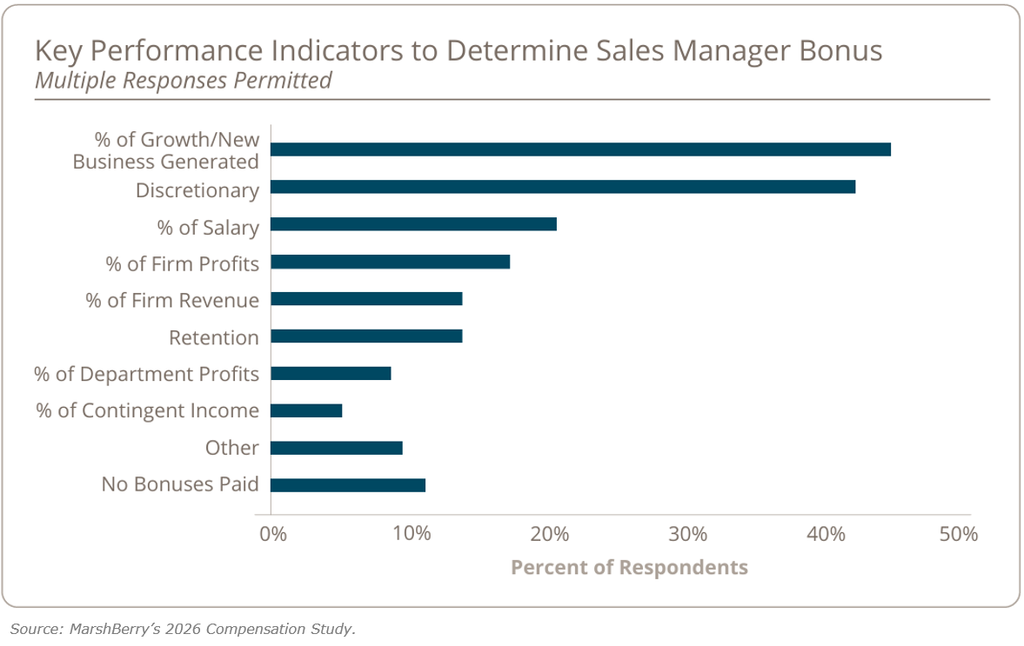
The best firms don’t necessarily pay the highest commission percentage, they appropriately reward new business, profitable growth, and long-term value creation. A 15 to 20 percentage point difference between new and renewal rates is typically recommended.
In a soft market, the gap between high performing producers and average producers widens. Leaders need to develop employees who can improve, differentiate rewards for high performers, and address persistent underperformance. Offering mentorship and guidance from experienced peers helps teams to prioritize effectively, think more strategically, and improve decision-making. Leaders should also define service level expectations. If a $500 account is receiving the same level of service as a $20,000 account, that’s a sign of misalignment in growth strategies and goals. This doesn’t mean smaller accounts should receive poor service, but service models should be intentionally designed around clients’ needs, complexity, revenue, and opportunity.
Hiring should become more selective and opportunistic
Hiring should focus on capability rather than simply filling vacancies. A soft market can create opportunities to attract high-quality talent, including candidates from outside the insurance industry who possess transferable skills in sales, client service, operations, or leadership. These individuals can learn industry-specific knowledge while bringing fresh perspectives and expanding the talent pool.
The same strategic mindset should apply to retention. Rather than treating all retention efforts equally, firms should prioritize investing in employees who create disproportionate value, including top producers, high-performing service professionals, future leaders, technical specialists, and individuals who embrace innovation and change.
Use technology as a force multiplier
Firms should view AI and technology as a force multiplier that increases employee productivity, enables account management teams to support more revenue without impacting client service, and gives producers more time to focus on selling. Tasks that once required significant manual effort, such as invoice processing, report generation, analytics, proposal creation, claims monitoring, and identifying cross-selling opportunities, can now be automated. This creates an opportunity for leadership to standardize workflows across the business, ensuring consistency, reducing errors, and improving efficiency. By automating routine processes, firms can deliver faster, more reliable service while freeing employees to focus on revenue-generating initiatives. The result is improved profitability, a stronger brand reputation, and the ability to drive growth without increasing payroll.
Measure and improve sales velocity
When premium-driven growth slows, true organic growth becomes even more important. Sales velocity (new business commission as a percentage of the prior year’s total commissions and fees) is one of the strongest indicators of how well an organization’s producers are performing. Therefore, regular review of sales velocity can uncover trouble spots and figure out if the firm is creating “real” organic growth.
To increase sales velocity, leaders should first examine whether the firm’s talent strategy is creating enough selling capacity. Are leaders coaching pipeline activity and conversion? Are producer incentives driving new business? Are service teams identifying cross-selling opportunities? Ultimately, the question is whether the firm is getting sufficient new-business production from the producer workforce. When market conditions soften, strong sales velocity can increase a firm’s relevance with carrier partners. For brokerage owners, strong sales velocity combined with scalable operating leverage and sustainable margins can also contribute to greater long-term enterprise value.
A soft market exposes whether a brokerage’s growth is being created by market conditions or by the business itself. In a hard market, premium increases can create growth and mask inefficiency. In a soft market, people and performance become the growth strategy. Better talent decisions can drive higher productivity, which in turn creates more selling and servicing capacity.
When the market hardens again, the brokerages that focused solely on cutting expenses may find themselves scrambling to rebuild capabilities. Those that invested in productivity, leadership, and organizational effectiveness will already be positioned for growth.
The value of a compensation study
MarshBerry’s comprehensive, one-of-a-kind industry report evaluates compensation trends across multiple roles in insurance brokerage. It provides over 100 charts illustrating respondent data and detailed insights into the results. The report allows insurance brokerages to benchmark where their firm sits in the range of industry peers on compensation approaches. It can reinforce their current approach or reveal areas for change.
As insurance brokerages continue to look for ways to grow their business, whether through their product offerings, service capabilities, or technology upgrades, people will always be at the root of everything they do. Having a top-performing organization with top-performing personnel starts with a top-performing compensation strategy.
Learn more about MarshBerry’s 2026 Insurance Agency & Brokerage Compensation Study.