
The first quarter of 2026 marked another busy quarter for U.S. accounting and tax firm mergers and acquisitions (M&A), continuing the momentum from 2025. The activity shows that the market is seeing structurally higher “run rate” of transactions, supported by repeat buyers and an growing number of buyers pursuing scale and strategic offerings.
Private equity (PE) remained the most active acquirer group in the accounting and tax M&A landscape, after accounting for over 40% of all transactions in 2025. The most significant acceleration has occurred over the past two years, signaling a structural shift in the market. This rise is meaningful because PE does not just support individual deals; it enables scalable growth strategies through sustained investment. The accounting and tax space is increasingly behaving like other professional services sectors such as wealth management and insurance brokerage that have already moved into sponsor-backed platform building.
With greater participation from private equity, firms are increasingly pursuing inorganic growth as a core strategy. Backed by capital, these platforms are investing in talent and technology while executing consistent add-on acquisitions. As regulatory barriers have become clearer and more manageable, PE investors have grown more comfortable in the space, further accelerating deal activity and competition.
At the same time, acquisitions are being used to broaden service offerings and enhance client value propositions. Firms are targeting strategic capabilities to build comprehensive, full-service platforms that improve client retention and support new business development. As a result, the accounting and tax sector is evolving to mirror other professional services industries that have already undergone sponsor-backed consolidation.
The buyer mix in Q1 2026 shows the consolidation story that began in 2025 remains relevant. The top ten acquirers represented roughly 31% of all deals, and nine of those ten were private capital-backed platforms. Firms such as UHY, Ryan, Doeren Mayhew, PKF O’Connor Davies, Aprio, Sax, Cherry Bekaert, Springline Advisory Holdings, and others are no longer occasional participants. They are potential consolidators with repeatable playbooks, using acquisitions to expand geography, broaden service lines, and build deeper operating infrastructure.
M&A market update
As of March 31, 2026, there were 61 accounting and tax M&A transactions announced across the U.S., continuing momentum after a record year for deal activity in 2025.
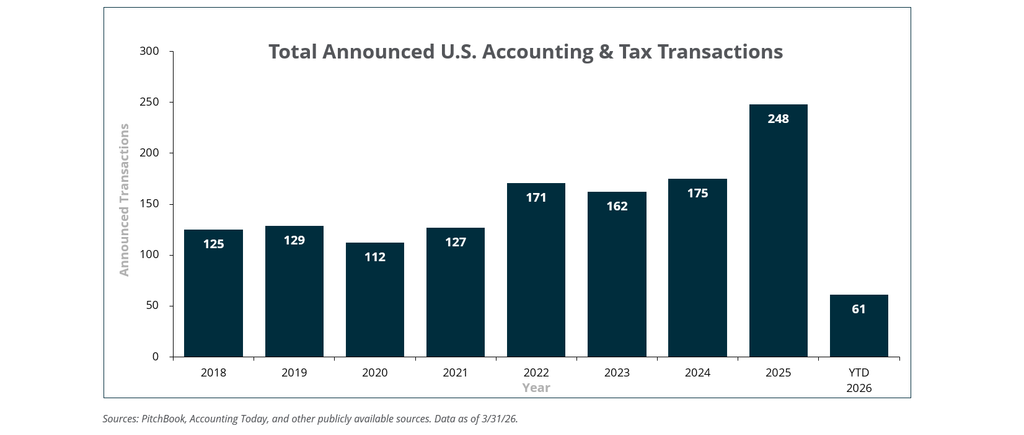
Private capital-backed buyers were responsible for 28 of those transactions in Q1 2026, representing 46% of total activity, compared to full year 2025 when they accounted for 41.5% of transactions. Independent firms completed 25 transactions, accounting for 41.0% of overall volume, while wealth management buyers announced five transactions during the first quarter of 2026. Pure tax firms represented three of the announced targets, or 5% of total deal activity.
Buyer concentration also continued to take shape. Ten acquirers were responsible for 31.1% of all announced transactions in Q1 2026, with the top three buyers (UHY, Doeren Mayhew, and Ryan) accounting for 11.5% of total volume alone. Institutional capital is continuing to shape the competitive dynamics and pace of consolidation within the accounting and tax sector.
Notable Transactions
- January 13: Cherry Bekaert acquired Tarsus, a Washington, D.C.-based accounting and advisory firm, to expand its outsourced accounting and CFO advisory capabilities. Tarsus provides services including bookkeeping, real-time financial and KPI reporting, and strategic finance support, with a strong client base across technology, government contracting, staffing, private equity, and professional services sectors. With additional offices in California, Missouri, and India, Tarsus adds geographic reach and specialized expertise to Cherry Bekaert’s platform. The acquisition strengthens the firm’s outsourced accounting services practice and enhances its ability to deliver integrated, data-driven financial solutions to a broader client base.
- January 16: DuvallWheeler LLP partnered with Seekye Capital, which acquired a majority interest in the Northern Virginia-based accounting and advisory firm to support its next phase of growth. Founded nearly four decades ago, DuvallWheeler will continue operating under its existing leadership and brand, with a focus on maintaining its client relationships and culture while leveraging Seekye’s resources. The investment is intended to enhance capabilities in areas such as technology, leadership development, and strategic planning, positioning the firm for long-term expansion and continued service delivery in an evolving professional services landscape.
- February 3: Doeren Mayhew acquired 1RDG, a Rochester, New York-based advisory firm, marking its entry into the New York market and adding two new office locations. Founded in 2005, 1RDG has evolved into an integrated platform offering compliance, management, and advisory services, with additional scale gained through recent partnerships with other regional firms. The transaction brings more than 100 employees and seven partners to Doeren Mayhew, expanding its capabilities across audit, tax, outsourced accounting, and advisory services, particularly in sectors such as construction, healthcare, real estate, manufacturing, and family offices. The acquisition supports Doeren Mayhew’s broader growth strategy, following a series of recent deals aimed at deepening geographic presence and enhancing service offerings.
2026 Outlook
MarshBerry expects consolidation across the U.S. accounting and tax landscape to continue accelerating, supported by the same structural drivers that have fueled recent activity – aging ownership, sustained private capital interest, and the growing need for scale to fund technology and specialized capabilities. As more firms evaluate succession and capital strategies, transaction volume should remain elevated, with both sponsor-backed platforms and strategic buyers actively competing for quality assets.
A key focus is how valuations evolve as recapitalizations from earlier private equity vintages begin to emerge. While premium multiples have defined the market’s upper end, increased recap activity may introduce greater pricing dispersion and influence how aggressively platforms pursue add-ons. Even so, firms with robust organic growth, differentiated capabilities, and strong leadership should continue to command premium valuations. At the same time, increasingly institutionalized acquirers – with proven sourcing and integration capabilities – are well positioned to drive higher deal volume, signaling a more mature and operationally focused phase of M&A growth.
