
For many independent insurance agency owners, perpetuation is something discussed only when retirement comes into view. Yet the decisions that determine future outcomes are made years, and often decades, before ownership actually changes hands. Whatever perpetuation strategy is being contemplated, the firms that remain in the driver’s seat are the ones that define their endgame early and make intentional decisions that support it along the way.
What’s the perpetuation endgame?
Insurance agencies that focus on growth today – often find they have far more choices available to them tomorrow. It’s important to recognize that, regardless of the chosen path, growth is the one common denominator that makes everything possible. Growth creates optionality. Agencies consistently achieving strong organic growth have access to a broader range of future opportunities, and some perpetuation structures, particularly certain internal options, take planning and often an extra element of time.
Agency owners have more perpetuation options today than ever before. Common perpetuation paths include internal ownership transitions, sales to strategic buyers, Employee Stock Ownership Plans (ESOPs), broker formations, and partnerships supported through debt or equity capital. Each path offers distinct advantages, challenges and requirements. But without a known destination, it’s difficult to map a path to reach it. And without a clearly defined succession strategy, it’s difficult to make clearly defined strategic decisions. Business structure, growth initiatives, ownership programs, recruiting efforts and capital investments all take on new significance when viewed through the lens of a long-term perpetuation strategy.
Internal succession starts with people
For many agency owners, internal perpetuation remains the preferred option. The possibility of maintaining independence, rewarding key employees and preserving culture all make internal succession highly attractive. Yet, due to various factors, successful internal perpetuation has become increasingly difficult to execute. One reason is surprisingly simple: Ownership transitions require the willingness to share ownership and leadership responsibility with the next generation well before any transition takes place.
According to MarshBerry’s 2026 Technology & Governance Report, nearly 75% of firms believe the next generation is capable of eventually taking over the business. However, only about 20% make stock ownership available to employees.
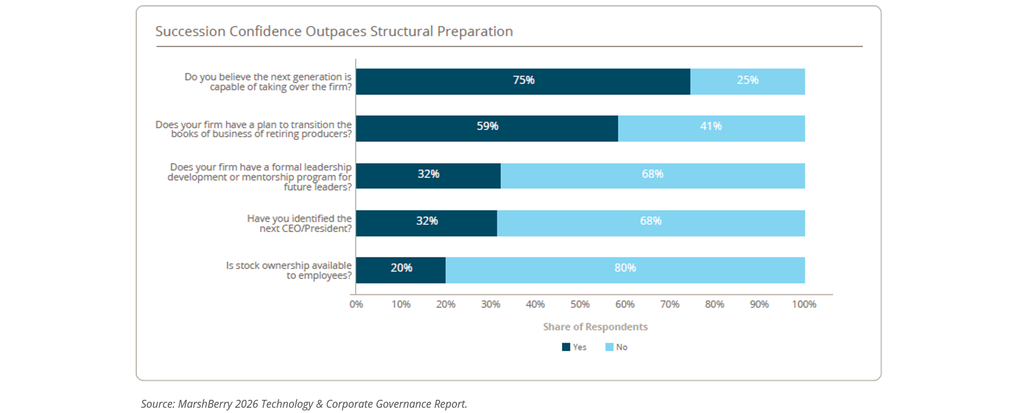
The gap between those two figures highlights a common challenge: Many firms believe they have future leaders, but relatively few have created a formal path to partnership. Interestingly, expanding ownership can do far more than solve a perpetuation challenge. It can create even greater revenue growth, create value, strengthen leadership development and provide greater strategic flexibility going forward.
The four pillars of successful perpetuation
Successful internal succession typically requires four key ingredients:
- People: Future shareholders must possess leadership ability, credibility among their peers and a genuine commitment to the agency’s long-term success. Equally important, they must be both willing and financially able to become owners.
- Planning: Ownership transitions rarely happen successfully through “good intentions” expressed during informal conversations. Agencies need documented valuation methodologies, shareholder agreements, buy-in structures and buy-out provisions that provide clarity for all parties involved.
- Financing: Ownership transitions require capital, whether through external financing, seller notes or other funding arrangements. Effective cash flow modeling becomes critical to ensuring that ownership transfers remain sustainable for both buyers and sellers.
- Culture: Succession must become part of the agency’s culture. Firms that remain independent across multiple generations tend to communicate ownership opportunities early and often. They position ownership not simply as a stock transaction but as a wealth creation opportunity that rewards long-term commitment and contribution.
Creating a path to partnership
One of the biggest mistakes agencies make is waiting too long to discuss ownership opportunities. Potential future shareholders need time to prepare financially and professionally. Conversations about partnership should begin years before ownership transactions actually occur. This gives future owners the opportunity to understand expectations, develop leadership capabilities and prepare financially for the investment required.
Clearly defined shareholder criteria can help support this process. Some firms establish objective requirements around tenure, production, technical expertise, professional designations and community involvement. Others supplement those requirements with subjective qualifications such as leadership ability, communication skills, accountability and a demonstrated willingness to mentor younger employees. Most successful ownership programs also require shareholder agreements outlining valuation methodologies, ownership restrictions and non-solicitation, non-competition and confidentiality provisions. These agreements help protect the business while creating clarity regarding future ownership transitions.
Looking ahead
Perpetuation is not a single transaction. It is the culmination of years of strategic decisions regarding growth, ownership, leadership development, areas of specialization and long-term strategic planning. The most successful transitions are the result of a clear vision, communicated early and supported by deliberate action sustained over time.
Whether the goal is an internal succession, a strategic sale or another ownership structure, agencies that invest in growth, develop future leaders and create pathways to ownership position themselves to keep more options available. By defining the endgame vision early, and making decisions that align with it, owners can help ensure the business they have built will continue to thrive long after the transition takes place.
This article is based on a presentation given at the FirstChoice In Motion Annual Member Conference 2026.
Interested in diving deeper?
FirstChoice members can attend the upcoming online event, “Are You Holding on to a Grape When You Could Own a Watermelon? Rethinking Ownership, Growth, & Your Agency’s Next Generation” to be held on December 3, 2026, at 02:00 PM Eastern Time (US and Canada). If you are not a FirstChoice member and are interested in attending, please reach out to us here.
Is FirstChoice, a MarshBerry Company, right for you?
FirstChoice is the premier network for independent agencies and your go-to resource to build agency value through our investments in carrier relationships, increased revenue, education, and technology. There is a reason FirstChoice is the top agency partnership three years running. Learn more about FirstChoice growth solutions if you are not already a member and are interested in the nation’s number one agency partner.