
For many insurance brokerages, the challenge is not in setting a strategic direction, it’s turning this direction into measurable, operational results. According to MarshBerry’s 2026 Technology & Governance Report, 51% of respondents have growth goals extending three to five years into the future, while another 35% are planning five years or more ahead. Nearly 70% of firms update their strategic plan annually.
However, these planning activities are not always translating into stronger performance: only 26% of respondents describe their current strategic planning process as “very effective” in driving company performance. More than half, or 54%, consider it only “somewhat effective,” while the remainder say their process is not effective or they do not know.
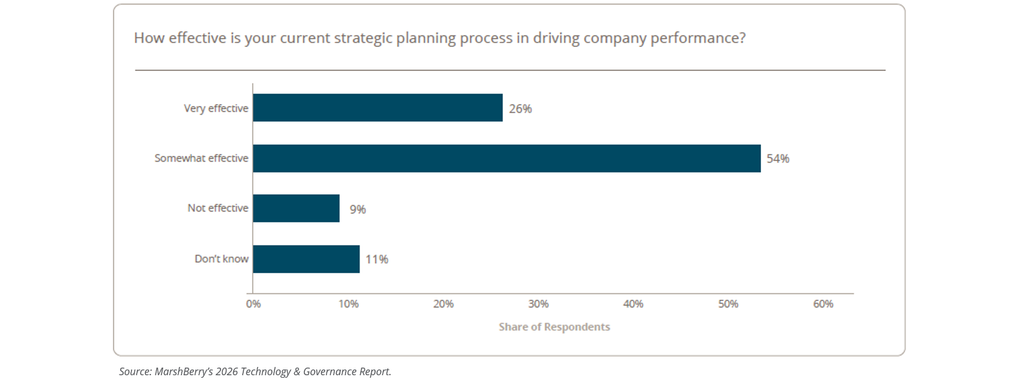
That gap is important. A strategic plan can articulate where a firm wants to go, but the plan alone is not enough to create results. Execution is also key in moving strategic planning beyond a periodic exercise and making it an ongoing management discipline. It needs to connect big picture objectives with near-term priorities, resource allocation, and individual accountability, in order to achieve impactful operational results.
Focus is key
Leadership teams can easily develop a long list of worthwhile initiatives: improve organic growth, recruit producers, invest in technology, pursue acquisitions, increase retention, develop future leaders and expand margins. But when everything becomes a strategic priority, then nothing is. Organizations risk spreading resources and leadership attention too thin.
Effective firms prioritize a limited number of objectives. They establish realistic timelines and sequence priorities based on expected impact and organizational capacity. This helps concentrate leadership attention and resources on the initiatives that matter most.
Those priorities should also begin with an objective assessment of the firm’s current position. Financial performance, market dynamics, talent, ownership structure and operational capabilities all influence what a firm can realistically accomplish. Starting with that baseline helps leadership develop a strategy grounded in the current state of the business.
Translate strategic goals into measurable objectives
Broad objectives such as “accelerate organic growth” or “improve operating efficiency” are difficult to execute without clearly defined responsibilities, milestones and deadlines. Effective planning requires translating broad objectives into specific actions and timelines. Defined owners, measurable objectives and predetermined deadlines give management a framework for evaluating progress and addressing obstacles.
Compensation can help with accountability, but the data highlights the broader challenge of connecting strategy to individual performance, as only 33% of firms report that their strategic plan affects employee compensation, according to the MarshBerry Tech & Governance survey.
Execution of the plan depends on communication
Communication should extend beyond announcing annual goals. Teams need to understand how their roles contribute to firm-wide priorities and how everyday decisions support, or even detract from, those objectives.
That requires ongoing reinforcement from leadership. Strategic planning best practices should emphasize communicating priorities beyond senior management; and aligning compensation, incentives and performance expectations with strategic objectives. The key is to reinforce desired behaviors while connecting individual performance with enterprise goals.
Conclusion
Strategic planning doesn’t end when the planning meeting is done. A strategic plan created once a year cannot anticipate the many shifts, such as market conditions changing and new opportunities arising, that a firm may encounter during the next 12 months. Establishing a quarterly or semi-annual cadence for reviewing progress, testing assumptions and adjusting as needed can be helpful. Additionally, regularly revisiting priorities helps keep the strategy relevant and adaptable.
Strategic planning is not simply an event on the corporate calendar. It is a planning process discipline of repeatedly connecting where the firm wants to go with what needs to be accomplished today.
MarshBerry can help firms assess current performance, identify priorities, establish measurable objectives and build accountability around execution. When strategy is supported by clear priorities, organizational alignment and a consistent review process, the strategic plan can become a framework for building, enhancing and sustaining enterprise value.