
Insurance brokerages have spent the last couple of decades (at least) becoming more data-aware. Leadership teams review dashboards, monitor KPIs and increasingly expect data to support decisions across sales, service, finance and operations. On the surface, that sounds like a data-driven industry. But MarshBerry’s 2026 Technology & Governance Study suggests a more complicated reality: Firms may be more confident in their ability to use data than their underlying infrastructure justifies.
The disconnect between confidence and capability
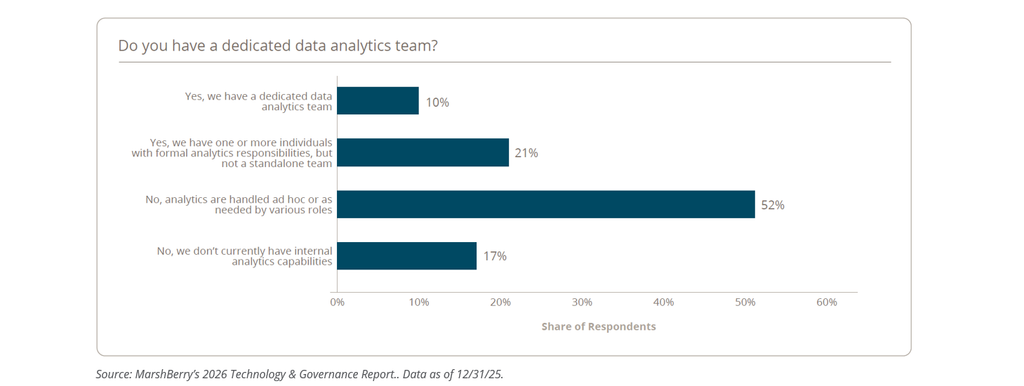
MarshBerry’s study discovered that, across all revenue bands, firms generally express at least some confidence in their ability to extract actionable insights from data. Yet only 10% of respondents report having a dedicated data analytics team, while 52% say analytics are handled on an ad hoc basis by various roles throughout the organization. Those numbers reveal real tension between what firms believe they can do and what they’re actually doing.
The same tension appears when firms describe the condition of their data. Only 27% say their data is well organized and ready to support analytics or automation. Nearly two-thirds (65%) say their data is only somewhat organized and will need cleanup or additional structure before it can be used effectively.
That gap matters because producing AI-generated reports is not the same thing as building a scalable data capability that AI can leverage to maximum effect. Human beings can take into account any “quirks” and inconsistencies in the way data is captured, producing accurate reports despite the lack of standardized definitions, governed data domains and reliable integrations. AI cannot.
Reporting maturity is only the first step
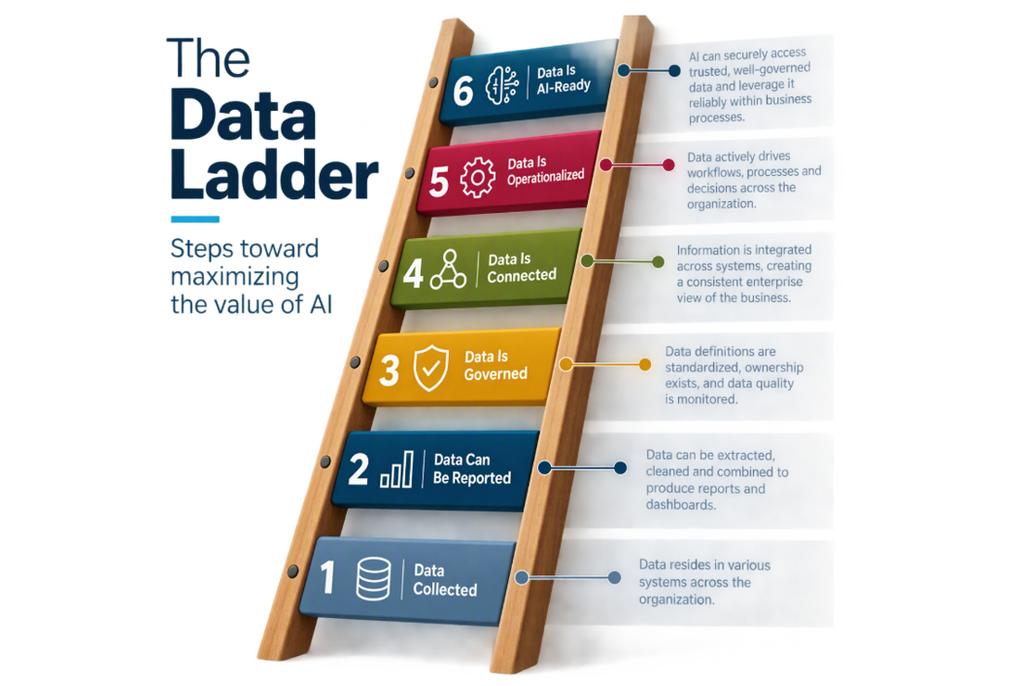
One way to think about the issue is as a data-maturity ladder that starts with the collection of data and leads to the ability of AI to extract, combine, analyze, report and project based on that data.
The term that gets a lot of attention, “dirty data” is only a second-rung issue. While a misspelled carrier name, a duplicate account or a missing field can be problematic, the more difficult constraints are architectural and organizational: A client may exist in multiple systems with no reliable identifier connecting the records. Two departments may calculate the same KPI differently. A dashboard may rely on transformations that only one employee understands. Valuable information may be technically accurate but stale. Key attributes may never have been captured at the level of detail required for the analysis that management wants to perform. And a large share of institutional knowledge may still live in emails, policies, notes and documents rather than structured databases.
MarshBerry’s study points in this direction. Among those firms trying to better organize or use their data, many respondents cite a lack of time or staff resources, but they also point to data being stored across too many systems, uncertainty around how to structure it for reporting and analytics, uncertainty around which data is valuable, and a lack of clear data ownership or accountability. Those are not simply cleanup problems. They are data architecture, governance and operating-model challenges.
AI is exposing the difference
This distinction becomes especially important as firms move from experimenting with AI to embedding it into business processes. Nearly three-quarters of the firms in MarshBerry’s study report using AI in some capacity, but most adoption remains exploratory or limited in scope. Sixty-nine percent report using AI-powered features within existing software platforms, while only 18% report using AI-powered workflow automation tools.
That makes sense. The first generation of enterprise AI asks relatively little of a firm’s internal data architecture. An employee can use AI to summarize a meeting, draft an email, compare documents or generate ideas without connecting the model deeply to the firm’s systems of record.
The next generation of enterprise AI is different. Asking AI to identify a retention risk, recommend a cross-sell opportunity, flag a profitability issue, prepare a renewal workflow or surface a producer-growth opportunity requires context from multiple systems, consistent definitions, and reliable data in order to be certain that the right client, policy, producer or carrier records are being connected.
Do not start by trying to clean everything
The solution is not to undertake a multi-year effort to make every field in every system perfect before doing anything useful. That approach is expensive, slow and often disconnected from business value. A more practical approach is to begin with the business capability the firm wants to create. Some examples:
- If the objective is identifying cross-sell opportunities, specific sets of data will be required to make that recommendation reliably.
- If the objective is understanding account profitability, then different data, covering revenue, compensation, servicing and client attributes will need to be connected.
- If the objective is predicting renewal risk, historical signals will need to be captured and aggregated.
That is a very different exercise from simply saying, “We need to clean our data,” one that creates a direct connection between data investment and business value.
What firms should build next
For firms looking to mature their data capability, several disciplines become increasingly important:
- Data ownership: Instead of treating data quality as everyone’s responsibility (and therefore no one’s), assign accountability for critical data domains.
- Common business definitions: Establish consistent definitions for the metrics and entities the firm depends on most.
- Integration architecture: Reduce dependence on manual extracts and one-off reconciliations between core platforms.
- Data-quality controls: Define the specific dimensions of quality that matter – completeness, accuracy, timeliness, consistency and uniqueness – and monitor them deliberately.
- Lineage and transparency: Understand where important metrics originate, how they are transformed and which source systems should be trusted.
- Use-case prioritization: Focus data investment on business decisions and workflows where better data can materially improve performance.
Not every firm needs a large, centralized data team. But every firm attempting to scale analytics and AI automation needs someone accountable for how enterprise data is defined, connected, governed and used.
The next phase of AI may be a data architecture story
The first wave of AI adoption has largely been about giving employees access to AI. The next wave will increasingly be about giving AI appropriate access to the business. That is a much higher standard.
The insurance industry’s challenge is therefore not simply whether firms have enough data or whether every record is perfectly clean. The more important question is whether the organization has built a data environment that can reliably provide context to analytics, automation and AI at scale.
MarshBerry’s 2026 Technology & Governance Study suggests that many firms have already developed confidence in using data while the underlying operating model is still maturing. That should not be interpreted as failure. It is the natural transition from reporting with data to operating with data. But it does change where firms should focus next. The organizations that move beyond dashboards and ad hoc analysis – toward connected data, common definitions, clear ownership and operationalized intelligence – will be far better positioned to extract measurable business value from the next generation of technology.