
Over the past decade, private equity (PE) firms have dramatically reshaped the registered investment advisor (RIA) industry. Drawn by recurring revenue streams, scalable business models, and attractive margins, PE sponsors have invested heavily in RIAs, fueling consolidation and creating some of the largest platforms in wealth management. These investments have driven rapid growth and transformed competitive dynamics, but now the industry is entering a new phase.
Is a recapitalization wave approaching?
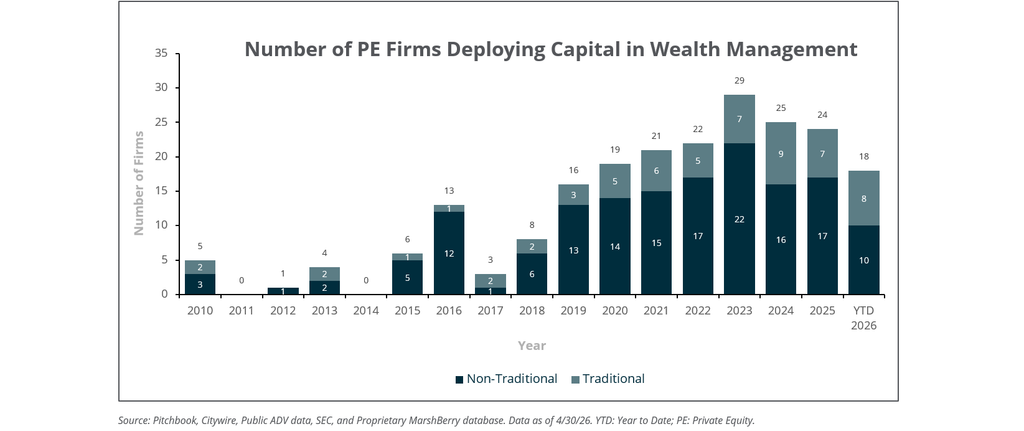
Many PE-backed firms are nearing the end of their typical investment lifecycle, generally three to five years. As funds mature, sponsors often seek recapitalizations or secondary transactions to return capital to investors while maintaining exposure to high-performing assets or to create liquidity while also preserving future upside. The current maturation of older-vintage deals may lead to a wave of recapitalizations and secondary transactions over the next 12–24 months. For independent advisory firm owners, understanding the potential implications of such a wave is essential for delivering optimal outcomes to shareholders, employees, and clients. As this chart shows, 2023 represented a peak for PE investment in wealth management, which means 2026 is ushering in the era where exits will begin to take priority.
Why this moment matters
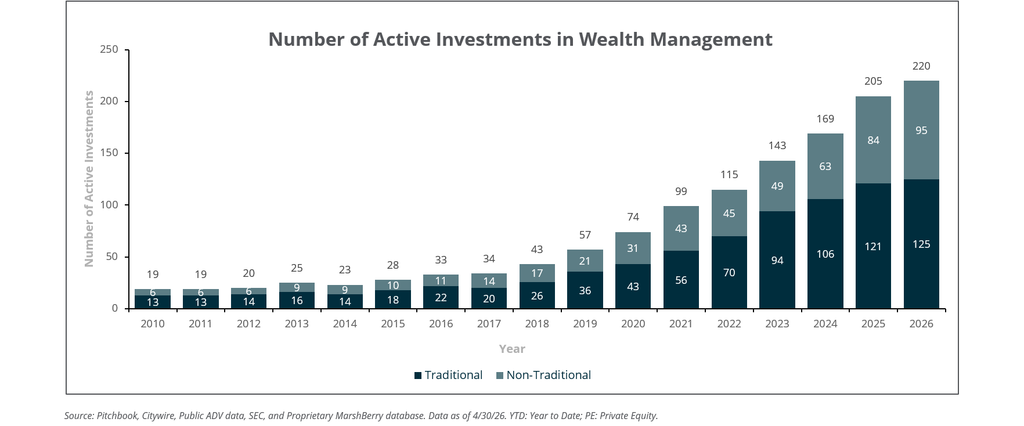
The current environment represents an inflection point for the wealth management industry. The way PE sponsors exit their investments will influence not only valuations, but also leverage structures, governance models, and growth expectations across the industry. This is especially true given that the number of PE-backed wealth managers has grown almost 5x since 2018, reaching 220 active investments in 2026, up from 43 in 2018.
Even if a firm is not PE-backed, these dynamics will shape competitive pressures, talent strategies, acquisition opportunities, and client perceptions. Whether leadership is evaluating the merits of outside capital or fully committed to remaining independent, understanding the implications of PE activity is critical for positioning any firm for long-term success.
Primary exit paths for PE sponsors
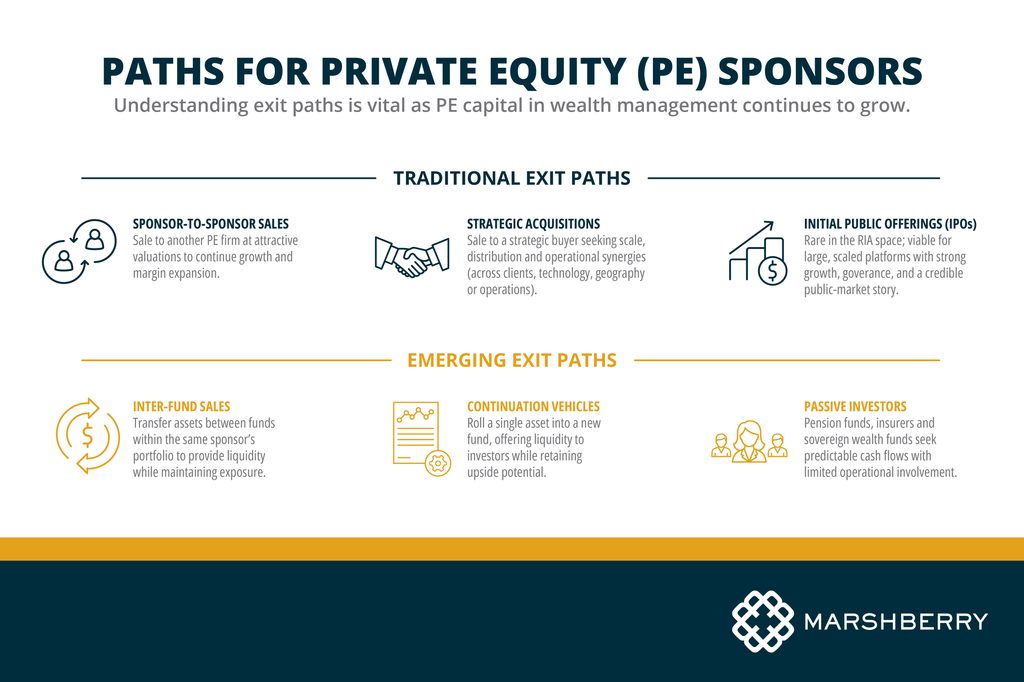
Historically, PE sponsors have relied on three primary exit paths: sponsor-to-sponsor sales, strategic acquisitions, and initial public offerings (IPOs). Each path carries distinct implications:
- Sponsor-to-sponsor sales: Currently the most common route, this involves selling an RIA platform to another PE firm. These transactions often occur at higher valuations because the platform has matured and demonstrated scalability. For advisory firms, continued PE ownership typically means sustained focus on growth and margin expansion, but also ongoing leverage and performance pressure.
- Strategic buyers: These buyers might include larger wealth managers, banks, insurers, asset managers, or financial services consolidators. Each of these entities pursue acquisitions that provide scale, distribution, and operational synergies. This is often the most attractive route because strategic buyers may pay for cost synergies, advisor distribution, client assets, technology, or geographic expansion.
- IPOs: While rare in the RIA space, they have occurred and can provide liquidity and boost brand visibility. This option tends to be viable only for larger, scaled platforms with predictable organic growth, strong governance, recurring fee revenue, and a credible public-market story.
There are also a few other emerging exit paths:
- Inter-fund sales allow sponsors to transfer assets between funds within their own portfolio, maintaining exposure while providing liquidity to existing investors.
- Continuation vehicles enable sponsors to roll a single asset into a new fund, offering liquidity to current limited partners while retaining upside potential.
- It is also becoming more common to see passive investors such as pension funds, insurance companies, and sovereign wealth funds getting involved as they seek predictable cash flows over operational involvement.
Implications for advisory firm owners
This industry evolution signals a broader trend in which the era of hyper-consolidation may give way to a period during which organic growth, integrated client experience, and operational efficiency become the primary differentiators. Firms that have remained independent must consider how to compete and retain enterprise value in an environment where scale and sophistication increasingly matter.
So, how do owners of a privately held wealth advisory firm navigate a future where many PE-backed firms are nearing the end of their typical investment lifecycle? Here are three key items that virtually every firm should add to its to-do list:
- Assess the firm’s capital structure and strategic objectives. Is the firm positioned for independence, a strategic partnership, or outside investment? Evaluate leverage, governance, and scalability to determine which path aligns with the organization’s long-term vision.
- Plan for growth beyond M&A. As the industry shifts toward organic growth, firms should diversify revenue streams and invest in an integrated client experience, technology, and talent development. These investments not only enhance competitiveness but also strengthen valuation in any future capital event.
- Engage in scenario planning. Model valuations under different exit paths and ownership structures, and understand the implications for liquidity, control, and culture. This exercise can help leadership make informed decisions about whether to seek outside capital or remain independent.
The bottom line is clear
PE’s next chapter will reshape wealth management. For independent RIA owners, the question is not whether the circumstances outlined above will affect a firm. They will. The real question is how to position the firm to thrive in this evolving landscape. Leadership must stay informed, plan ahead, and make decisions that align with the organization’s long-term vision for the business, the team, and the clients.
Whether the plan is to remain independent, pursue strategic partnerships, or explore outside capital, the key is to act deliberately and proactively. The firms that succeed in the next decade will be those that anticipate change, adapt to new realities, and maintain a relentless focus on delivering value to clients.