Wealth management merger and acquisition (M&A) activity continued to build through October, bringing the year-to-date total to 326 announced transactions. This represents a 3.5% increase over the 315 transactions announced through October 2025, further extending 2026’s lead over last year’s record-setting pace. The sustained level of activity underscores the continued strength of the market and the durability of consolidation across the wealth management landscape.
Wealth management M&A activity continues to reflect a broader shift in how advisory firms plan for the future. For owners weighing their next move, a transaction can address several priorities at once, from creating a path for leadership transition to accessing resources that would take years to build independently. As 2026 enters its final quarter, these decisions remain closely tied to each firm’s long-term business objectives.
For buyers, successful consolidation depends on how well an acquired firm fits within the broader organization. Client service philosophy, advisor incentives, and the ability to integrate operations all influence whether a partnership delivers its intended benefits. Sellers face similar considerations as they assess how a transaction will affect their teams and clients. With a range of ownership and operating models available, clearly defined priorities can help firm owners identify partners best positioned to support their next stage of growth.
M&A market update
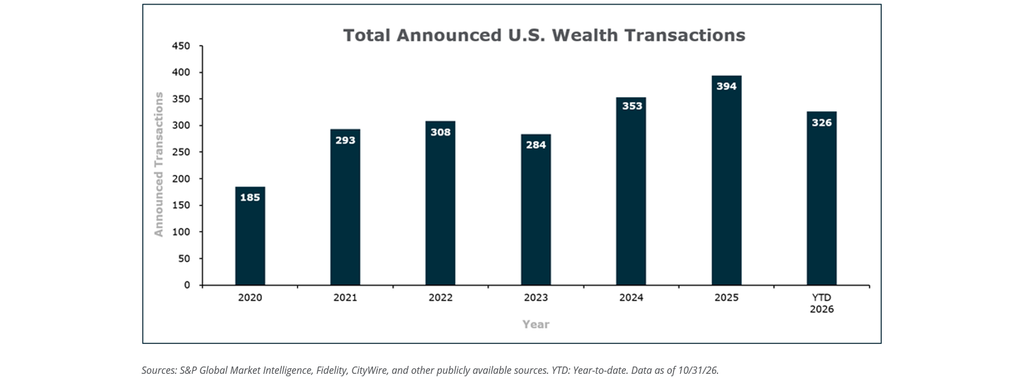
Private capital-backed buyers accounted for 237 of the 326 transactions (72.7%) through October, slightly down from the 2025 year-end figure of 74.0%. Independent firms accounted for 71 deals and 21.8% of the market, which is on pace with 2025’s final percentage of 2.8% (on 86 total independent deals). Insurance brokerages acquired 18 wealth management and retirement firms in 2026.
The top 10 buyers represented 33.4% of total transactions, and the top three acquirers (Wealth Enhancement, Hightower, and Carson) accounted for 18.4% of all announced deals. At the same time, geographic dispersion reinforces the breadth of the current market environment. A total of 42 states recorded wealth management M&A activity through October, with California leading the country at 28 transactions, underscoring both the depth and national reach of ongoing consolidation.
Notable transactions
October 7: Bluespring Wealth Partners acquired Family Wealth Counseling, a Torrance, California-based advisory firm, and subsequently merged the business with KDI Wealth Management, an existing Bluespring affiliate headquartered in Scottsdale, Arizona. The combination creates a wealth management firm overseeing approximately $1 billion in assets, with 16 professionals, including eight advisors. Both firms specialize in comprehensive financial planning for high-net-worth families and business owners, with particular expertise in serving women and clients navigating business succession, retirement, and inheritance. The transaction strengthens Bluespring’s presence in the Western U.S. while expanding its capabilities in succession, exit, and legacy planning.
October 8: Hightower Advisors acquired Synergy Capital Solutions, a Bloomfield Hills, Michigan-based wealth management practice overseeing approximately $1 billion in assets under management, integrating the firm into its Hightower Signature Wealth platform. Synergy has partnered with Hightower since 2017 and brings a multigenerational team of 15 professionals, including seven advisors, serving affluent clients across the U.S. The transaction expands Hightower Signature Wealth’s national presence while providing Synergy with enhanced investment, technology, and operational resources. Following the acquisition, Hightower Signature Wealth oversees approximately $40 billion in AUM across more than 35 locations nationwide.
Looking forward
Looking ahead, wealth management M&A remains supported by long-term succession needs, continued investor interest, and the resources required to operate a growing advisory business. As firms plan for 2027, preparation will be an important factor in their ability to pursue a successful transaction. Buyers will need to balance acquisition opportunities with the capacity to integrate new teams and support organic growth, while prospective sellers can benefit from strengthening financial reporting, developing leadership, and clarifying ownership objectives. With transaction processes often spanning several months, the work firms undertake today will help shape both their readiness and the opportunities available to them in the year ahead.