
MarshBerry’s semiannual Connect Summit was held on April 28-30, 2026, at the JW Marriott Camelback Inn Resort in Scottsdale, Arizona. Connect is an executive peer exchange program for firms who believe in learning from the success of leaders who have gone before them. The Connect Summit is an invite-only, membership event that gives firms the opportunity to dive into firm-specific data and financials with their Strategic Issues Groups (SIGs) as part of the peer exchange. The event is intended to help hold peers accountable to the action items each firm has selected, to improve their business, and to drive change within their organizations.
The Spring event brought together over 285 like-minded industry professionals – including Connect members, MarshBerry advisors, strategic partners, and guest firms – for engaging industry thought leadership and in-depth SIG working sessions.
Here are some of the highlights from this spring’s event:
MarshBerry CEO John Wepler’s State of the Industry
John Wepler kicked off the Connect Summit with his much-anticipated State of the Industry. The presentation highlighted that the insurance brokerage industry is entering a period of heightened uncertainty and accelerating change, requiring firms to be more strategic and adaptable than ever. Ongoing interest rate uncertainty, inflationary pressures, and geopolitical risk have contributed to a more volatile and less predictable environment for firms. While equity markets remain relatively strong, growth has slowed, and valuations – once boosted by favorable conditions – have plateaued.
A key trend is the widening gap between high-performing firms and others. High-performing, privately held firms are currently leading in organic growth. Meanwhile, firms unable to sustain strong organic growth are losing relevance and facing valuation pressure. Investors are becoming more selective, focusing on performance, integration, and operational excellence.
The central challenge identified is “clock speed,” or the ability of organizations to adapt and execute quickly in an environment where change is accelerating exponentially. Success now depends on faster decision-making, continuous adaptation, and investment in technology and talent.
Ultimately, firms must evaluate the durability of their value and growth strategy. Those that can scale, maintain strong sales performance, and adapt quickly will continue to command premium valuations, while slower-moving firms risk falling behind in an increasingly competitive and fast-paced market.
Keynote Speaker Chris McChesney: Get Results through Predictable Execution
Best-selling author of The 4 Disciplines of Execution and global practice leader of execution for FranklinCovey Chris McChesney has helped thousands of organizations get results through predictable execution. He has spoken in 22 countries on six continents and is one of the highest-rated speakers for the Global Leadership Summit.
Chris McChesney’s keynote at Connect centered on a core execution challenge: not strategy, but the inability to execute amid daily demands. He described the tension between the “whirlwind” – the urgent work of running the business – and initiatives aimed at future growth. While firms set clear goals and build early momentum, these priorities often lose steam due to daily operational pressures. Execution fails not due to poor ideas, but because organizations struggle to maintain focus.
Mr. McChesney says, “Inside of every organization or person is a clash between two forces: the whirlwind (aka the energy to keep the doors open), and the other side – the goals to move the organization forward.”
To address this, he introduced the 4 Disciplines of Execution (4DX), a framework for turning strategy into results. The first discipline – focusing on the “wildly important” or “what should be put in the ICU” – calls for narrowing priorities to one or two critical goals, as pursuing too many initiatives reduces the likelihood of successful execution. These goals must be clearly defined with measurable targets and timelines and integrated into daily operations.
The remaining disciplines drive execution through behavior and accountability. Focusing on “lead measures” shifts attention to controllable actions, while a visible scoreboard helps teams track progress and stay engaged. A regular cadence of accountability ensures ongoing focus, with teams reviewing results and committing to next steps. Ultimately, execution depends less on ambition and more on disciplined focus, systems, and consistent follow-through.
Real-Time Perspectives: Live Dialogues with Market Movers in Axis
In Axis, a dedicated space at the event, members had access to a unique opportunity to expand their networks beyond their peer groups, engage directly with strategic partners, and learn more about using technology to optimize growth. This thought leadership included a deep dive into how high-performing firms are adopting, integrating, and maximizing key technologies.
The Membership Address offered by Brooke Liu, MarshBerry Senior Vice President, focused on technology and operational challenges: while most firms understand the strategic direction required to grow, far fewer have made the structural and operational changes necessary to execute effectively. Drawing on MarshBerry’s 2026 Technology & Corporate Governance Report, Ms. Liu highlighted that technology has become a baseline requirement for scale. While AI, automation, and data integration are widely seen as essential, adoption remains limited in scope with most firms not yet integrating them into core operations.
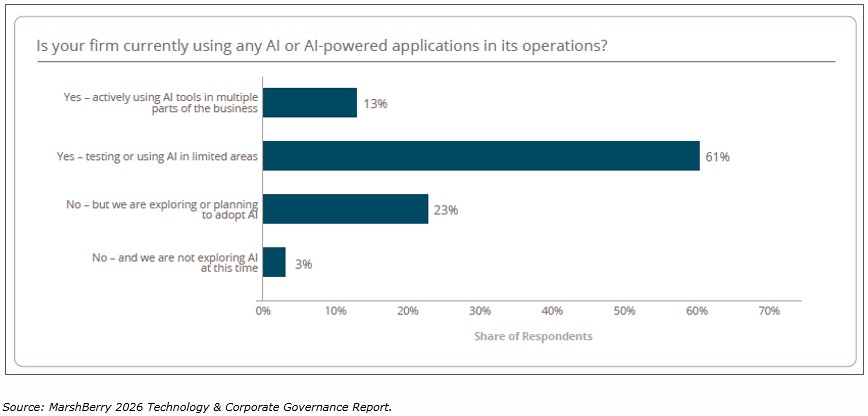
Another theme was the gap between ambition and execution across firm sizes. Ms. Liu highlighted that firms in the $10–$20 million revenue range face a critical inflection point: they have outgrown legacy systems but have not yet invested enough to modernize their technology and operations. This creates a “complexity gap,” where operational demands exceed their ability to effectively use technology. The main barriers are time constraints, competing priorities, and implementation challenges – not lack of awareness. Larger firms, by contrast, have largely completed integration efforts and are better positioned to scale.
Data and governance remain foundational challenges. Despite confidence in analytics, many firms struggle with fragmented data, limiting the impact of analytics and AI. Ultimately, sustainable growth will favor firms that move beyond experimentation and make strategic, integrated investments in technology, data, and organizational structure.
Tech Forward: How High‑Performing Firms Adopt, Integrate, and Maximize Modern Insurance Technology
MarshBerry’s Tech Forward panel featured executives from these high-performing firms:
- Daren Hopper (President), Sea Mountain Insurance
- JJ Johnson (Vice President), Sizemore Insurance
- Dylan Swarts (CFO), Swarts Manning
- Kyle Dean (President & CEO), Dean & Draper
- Laura Deeley Bren (President), Deeley Insurance Group
The Tech Q&A panel focused on the growing role of AI and the practical challenges firms face in adopting new technology. Panelists emphasized that the biggest barrier is not access to tools, but changing behavior. JJ Johnson emphasized that “buying technology is easy, changing behavior is hard.” Successful adoption requires clear ownership, staff involvement, and alignment with existing workflows. Firms are increasingly leveraging AI to drive efficiency, from automating proposals and policy checks to streamlining data processing tasks that once took hours but can now be completed in seconds. However, speakers stressed that technology investments must be tied to real business problems and measurable outcomes, such as increased productivity, higher revenue per employee, and expanded capacity.
A recurring theme was that failing to adopt AI is now one of the biggest strategic risks. Panelists outlined a progression of AI maturity – from basic use cases and training systems for repeatable tasks to ultimate, “agent operator” models where AI manages workflows with minimal manual input. Achieving this requires strong data foundations, clear implementation plans, and a mindset shift across the organization. Firms that succeed are those that prioritize high-impact and practical use cases, and view AI as a way to streamline manual work and reallocate resources towards client relationships and other high-value activities.
Enhance Impact: Collaboration, Networking and Optimizing Resources
The Connect Summit is thoughtfully designed to amplify the attendee experience through engagement with members and forward-thinking SIG sessions, all aimed at optimizing firm growth. Stepping away from the day-to-day to focus on the business allows for a renewed perspective. United by shared insight and peer collaboration, insurance executives are empowered to amplify their vision, optimize performance, and engage in meaningful action for the future.
Members, save the date for the next Connect Summit from September 15-17, 2026, in Austin, TX. If you’re not a member and are interested in how your firm can out-perform, out-earn, and outlast the competition, learn more here.