
Leaders achieving growth from new business are inevitably forced to evaluate the firm’s productivity to accommodate growing demands on client services and firm operations. Whether its staff asking for more teammates to cover a growing book or variance in service workflows making it difficult to onboard new employees, what used to work for firms in the past may not work in the future. Operating procedures should be evaluated and optimized as well, ensuring disciplined management of the expense structure.
Talent and technology continue to be the top two topics tackled within Connect, MarshBerry’s Executive Peer Exchange membership. Talent pools for the insurance industry continue to be limited, even as growing firms see their book sizes grow and staff capacity shrink. With new technologies and AI solutions seemingly popping up overnight, there must be efficiency solutions related to productivity pain points, right?
Furthermore, as the insurance market is shifting from a prolonged hard rate cycle environment into a softening one, firms are seeing more competition and slower premium increases, leading to pressure on organic growth rates.
So how do firms enable existing employees to work smarter, not harder? Tracking metrics like MarshBerry’s Critical Performance Indicators (CPIs) is key to strategic improvement, as firms can use data to boost results in key areas. It can also help determine if there are competitive enhancements, such as potentially leveraging technology, AI and peer insights, that can drive improvements in services and operations.
Here are three ratios that can help a firm measure productivity and benchmark against peers to identify areas for improvement.
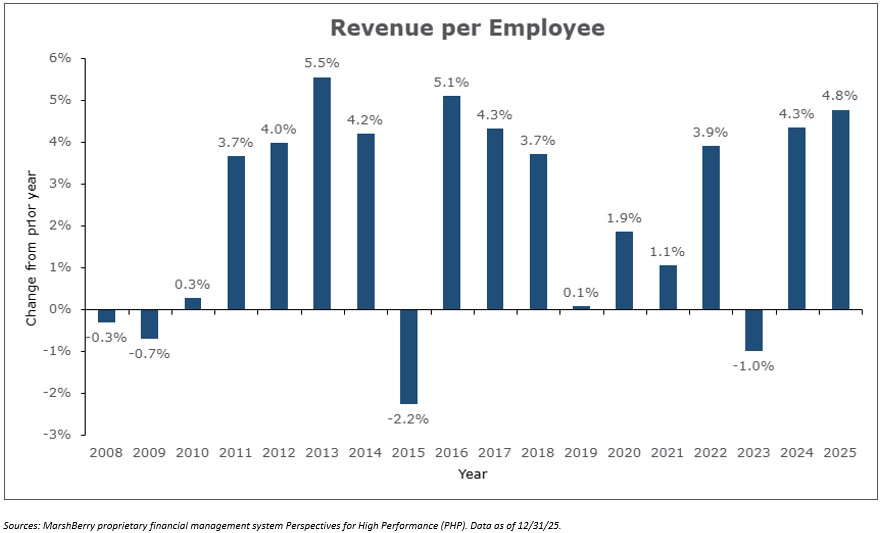
1. Revenue per employee
This metric measures employee productivity for all sales, service, and support staff. Generally, the higher this number, the greater the employee productivity.
Many insurance brokerage firms are starting to see improvement in this area. In fact, the revenue per employee metric has steadily increased since 2015. While rate lift from the recent hard market may positively contribute toward this increase, MarshBerry’s clients have cited other initiatives that drove greater staff efficiency and productivity.
The leadership of 2025 National MAX Performer Winner Associated Agencies chose a multi-faceted strategy to achieve double the average productivity performance, according to MarshBerry’s proprietary financial management database Perspectives for High Performance (PHP). President Josh Herz shared with MarshBerry about first conducting a book analysis to determine 90% of the firm’s revenue was coming from 10% of their clients, which prompted Associated to create select business unit with different service expectations customized for each tier. This approach enabled Associated to set clear target account size goals for producers, while top performers focused their efforts within major and minor verticals. From there, Associated could better identify investments for the top specialties to drive further growth and retention.
2. Support staff as a % of total personnel
This metric measures the proportion of non-client facing staff to total employees. Drilling down, it assesses the efficiency of non-client-facing employees. Support personnel support the entire organization rather than a specific department. Support functions include accounting and finance, general office management, human resources, and information technology personnel.
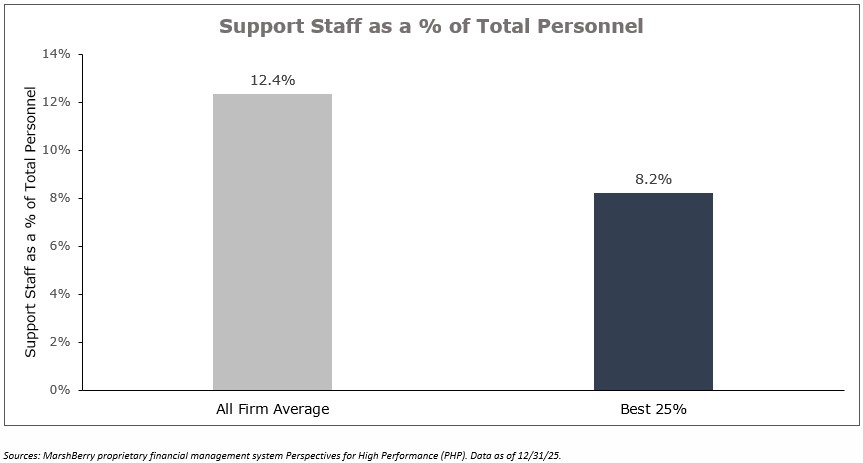
Increases in support staff efficiencies are often linked to the adoption of new technology and tools that enhance operational efficiencies. While insurance services and marketing technologies are entering the scene, AI and other efficiency tools have been available to support disciplines for a longer period of time.
For human resources, drafting organization charts, writing job descriptions, and screening candidates were tasks that took hours – but now they can be completed in minutes with the help of AI.
For finance, software to audit and correct accounting and reporting tasks have become smarter and more accurate.
While these investments may not have an obvious impact to a firm’s growth metrics, they often increase capacity for support staff resulting in more resources to invest in growth initiatives or increase profitability.
3. Total commissions & fees (TCF) per service person
This ratio is a good indicator of service team efficiency, linking service staff productivity to firm revenue. It depicts the relationship between a firm’s revenue and the volume of business managed by the service staff.
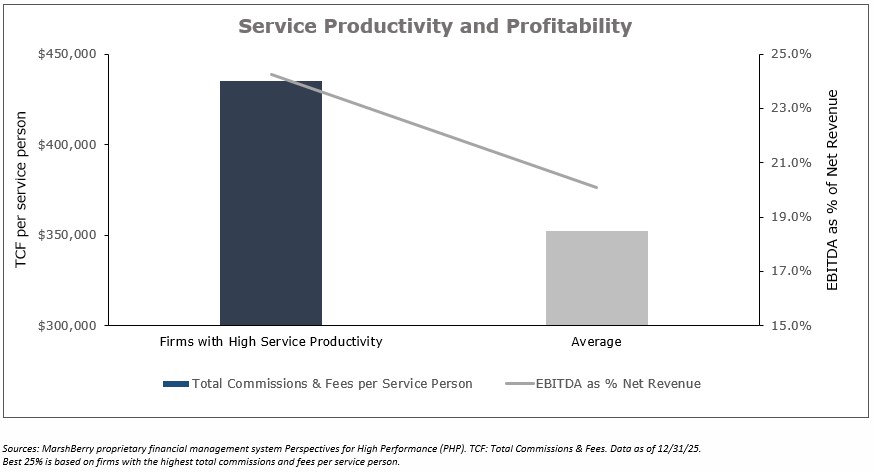
Firm owners can use this metric to optimize staffing relative to their book of business. If TCF per service person is below average, there may be room for the book to grow without assigning additional FTE support. However, having the peak performance TCF per service person may contribute to overly stressed staff.
Certainly, having a tiered service model, outsourcing lower-level service tasks, or adopting technologies can result in a lift to the TCF per service person, but metrics that are too high could result in greater staff turnover.
Increases in service efficiency can be linked to more than technology adoption and workflow standardization. MarshBerry’s PHP data shows that higher pay correlates with stronger performance, productivity, and organic growth. PHP data also indicates that higher profitability is correlated with service payroll increases. Raising service staff payroll (either through pay increases or new hires) tends to reduce the need for producers to service accounts. Instead, producers will be able to better focus on writing new business, contributing to better profitability for the firm.
Why these ratios matter
By measuring productivity with data and benchmarking, firms can gain staffing clarity and track efficiency initiative progress. Firms that follow the path of data-driven insights, strategic improvement, and continuous measurement can achieve significant growth and profitability. As competitors enhance their business results with data and benchmarking, and as the market environment continues to shift, firms must understand their position in the industry to effectively prioritize best practices and adapt to a rapidly evolving landscape – or risk being left behind.
Are you ready to Connect?
You can learn even more about how to take advantage of CPIs by becoming a MarshBerry Connect member. Members gain access to exclusive market intelligence as well as an invaluable peer-to-peer exchange network. Learn more here.