
As the insurance market softens and the AI revolution gains exponential momentum, how can brokerage leaders control their future and redesign their firms to be investment-grade?
The insurance brokerage industry is entering one of the most consequential periods in its modern history. After more than eight years of favorable market conditions, the property and casualty (P&C) insurance market has softened. At its most basic level, this means a slowdown in premium rate increases, or in some segments, decreases altogether. At the same time, AI is rapidly moving from an emerging technology to a business necessity.
Individually, either trend would be significant. Together, they create a perfect storm for risk – and for opportunity.
As insurance brokers face pressure on their rate-driven revenue and profitability, they are also being challenged to invest in technology, data infrastructure, automation and AI-enabled workflows in order to remain competitive. For those firms that have spent the past several years strengthening operations, diversifying revenue and building scalable technology platforms, this moment presents a tremendous opportunity. For those that relied too heavily on market conditions to drive growth, the risks are rising exponentially.
There is a growing separation within the insurance industry. One that will separate the winners from everyone else. Because in good times, prosperity conceals weaknesses, while in bad times, adversity reveals strengths.
Investment-grade vs. cycle dependent firms
This is the beginning of an investment-grade test for the industry. An investment-grade brokerage is one with durable organic growth, scalable operations, strong leadership, technology readiness, disciplined reinvestment and differentiated client value – qualities that make the business attractive to sophisticated investors through the cycle. On the other side are cycle-dependent firms, whose growth, profitability and value remain more reliant on favorable market conditions.
Today, the gap is widening between investment-grade firms and average firms. The difference can already be seen in organic growth rates, profitability, talent attraction, operational efficiency and valuation. Those firms that recognized that their organic growth over the past several years was heavily supported by market conditions and were preparing for those conditions to eventually end – are now positioned to thrive. Those that acted as if hard market conditions would continue indefinitely now find themselves struggling to keep up.
Every soft market creates winners and losers. But this one is different because it is arriving at the exact moment technology is reshaping how insurance is sold, serviced and delivered. The next generation of brokerage leaders will be judged not only by how they navigate a softer market, but by how effectively they leverage AI to create value for clients.
The insurance industry’s resilience is well known
The insurance brokerage industry has long been admired for its resilience. Economic downturns, recessions, geopolitical uncertainty and market volatility have historically had less impact on insurance distribution than on many other industries. That resilience is being tested as one of the longest hard markets has come to an end. After more than 33 consecutive quarters of increasing rates (8.25 years), P&C insurance pricing has softened. The first signs of change became apparent through public broker performance in Q1 2025, as organic growth rates began moderating – reaching an average rate of 3.2% growth in Q1 2026.
However, based on the public brokers’ Q2 earnings reports – that resilience by the insurance industry may be on full display. While the broader economic outlook still points to a continued soft market and declining P&C pricing, the public brokers displayed a modest rebound in organic growth in Q2 2026 with an average of 3.7% (a half point improvement over Q1 2026). Several of the public brokers stated that they have offset softened rates through stronger new business production, higher retention and client exposure growth.
So, while the insurance industry’s resilience will surely remain intact, this shift in the insurance cycle will be more about defining which brokers will be able to survive this evolving environment, and those that will get left behind.
What does a soft market look like?
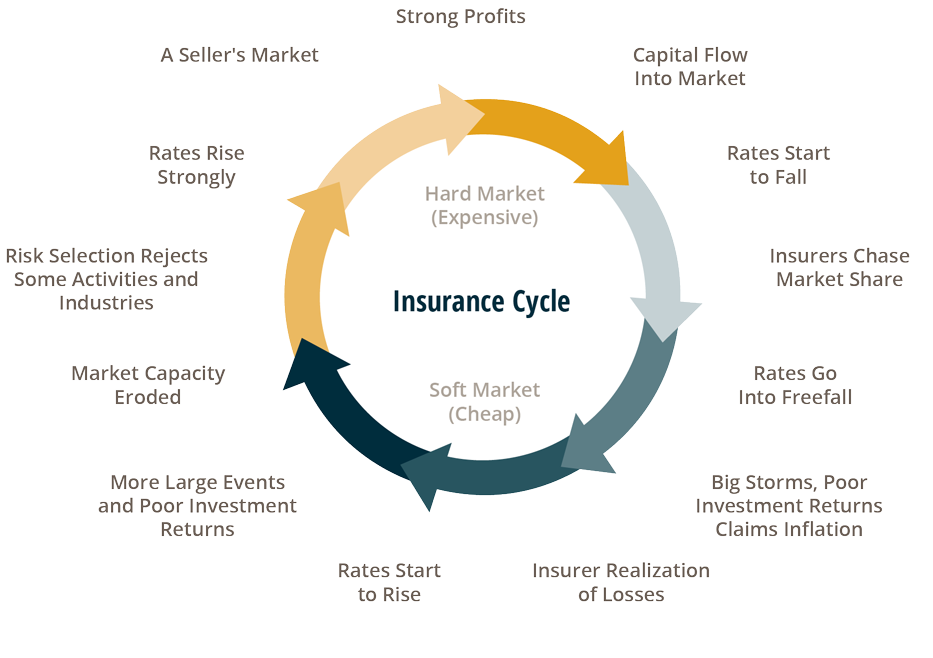
A soft market is often reduced to one simple phrase: lower premiums. In reality, it is much more complex. A soft market represents a phase in the insurance underwriting cycle characterized by increased carrier capacity, aggressive competition, broader coverage terms, higher available limits and flat-to-declining premium levels. Carriers become more willing to compete for business, underwriting appetites expand and accounts that may have faced difficult renewals in prior years suddenly have more marketplace options available.
For clients, this can be welcome news. For brokers, however, the implications are more nuanced. In many ways, a soft market reveals the flawed firms and all their weaknesses. Was growth during the hard market being driven by premium rate increases or strong sales velocity (new business commission as a percentage of the prior year’s total commissions and fees)? Was profitability simply the result of positive market conditions or outstanding operational discipline? Were client relationships simply maintained by managing renewals or strengthened by providing strategic advice? The answers to these questions will determine how a firm will weather this shift in the cycle.
Lessons from previous soft markets
History can provide a valuable perspective. The most recent significant soft market generally lasted from 2013 through 2017, approximately four and a half years. Several factors contributed to that environment, including abundant carrier capacity, strong reinsurance markets, relatively favorable catastrophe experience and increased competition among insurers seeking growth.
Prior to that period, the industry experienced an extraordinarily long soft market (13 years) that stretched from approximately 1988 through 2000. That era was driven by slightly different forces. Throughout the 1990s, insurance capacity significantly exceeded demand and carriers competed aggressively on price. High interest rates and profitable investments also provided other ways for insurers to make money, reducing pressure on underwriting performance.
The landscape today is different from the 1990s. Despite the high profitability of insurers during the past hard market, risks today are still much greater than during past soft markets. Risks such as cyber losses, nuclear verdicts, social inflation and climate-driven catastrophe volatility are all contributing to potential underwriting losses. With better technology, underwriting discipline is far more in tune with emerging risks. As a result, it may not take much to slow or reverse a soft market.
The lesson for brokers is straightforward: planning around market cycles alone is dangerous. The firms that build sustainable growth models are successful regardless of where the cycle sits.
Why a soft market may be good for the industry
At first glance, few brokers celebrate the arrival of a soft market. After all, slower revenue growth and increased competition are rarely welcomed by brokerage executives. Yet soft markets often provide one of the best stress tests of broker quality.
For the best performing firms, the short-term pain of a soft market will be minimal. Ultimately, they know that in the long run, it will be very beneficial to them. It’s their version of survival of the fittest. A soft market creates opportunities to gain market share, recruit top talent and strengthen competitive positioning while others are retrenching. Top performing firms can shift the conversation away from price, advise more on client risks and deepen their relationships with clients. Because of their previous profitability, they can reinvest in analytics, technology and advisory capabilities that will improve client outcomes. They use changing market conditions as an opportunity to differentiate themselves even further.
For the average broker, the past several years has created complacency. While the hard market may have helped them deliver positive financial performances, most have failed to build best-in-class leadership, and haven’t provided differentiated solutions to their clients. These firms are highly susceptible to the tides of market conditions. This is a high-risk approach to running a business, and now that the soft market is here – many won’t survive.
What does a soft market mean for valuations?
One of the most common questions surrounding market transitions is how valuations will respond. The better question may be this: How much wider will the gap between high-performing firms and average firms get?
It is MarshBerry’s belief that valuations will continue to be influenced by moderate supply vs. high demand. Strategic acquirers, private equity-backed platforms and sophisticated investors continue seeking growth opportunities throughout the insurance distribution landscape. As premium rate increases slow, the pressure to generate revenue to replace slowing organic growth will transition towards greater M&A strategies, and demand for quality firms will increase even further.
However, not all firms will benefit equally. Buyers are already placing greater emphasis on the factors that truly drive long-term enterprise value. They are seeking firms that bring scale, specialization, technology readiness and organic growth discipline that does not rely on market conditions – and they are willing to pay premium valuations. Others without these attributes will struggle to maintain elevated multiples. In practical terms, this is the investment-grade distinction: durable firms that can produce growth and enterprise value through the cycle versus firms whose performance remains more cycle-dependent.
AI implementation may be the differentiator
During this softening rate environment, with organic growth rates declining, firms are being challenged to increase their spend on technology (specifically AI) that is intended to improve their efficiency, significantly scale their business and drive greater revenue.
The timing for this AI revolution couldn’t be worse. But for those that understand it, embrace it, and implement it correctly – AI may simultaneously provide one of the greatest growth opportunities the brokerage industry has ever seen.
Currently, as AI moves from emerging technology to industry standard, many firms still remain in the experimentation phase with AI, using it only for limited tasks rather than embedding it into core business processes. According to MarshBerry’s 2026 Technology & Corporate Governance Report, only 13% of firms surveyed are using AI in an operationally impactful way.
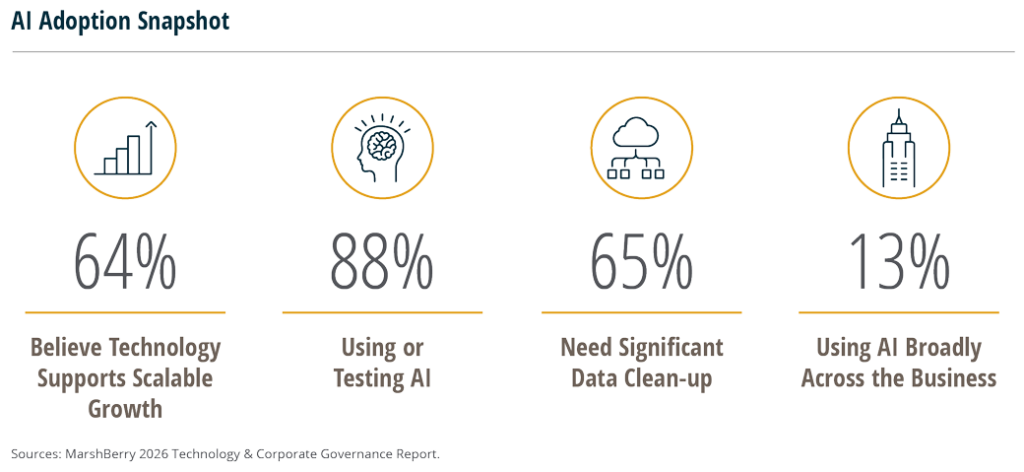
The real benefits of AI – its ability to create efficiency, speed and scalability, freeing up human capital for reinvesting in growth and higher-value advisory work – is still being realized. For the best firms, the capacity and economic gains created by AI will not simply fall to the margin; they will be redeployed into time, people, tools and resources that deepen client relationships, improve the quality of advice and help reduce the frequency and severity of claims. Once firms master these benefits, AI will dramatically increase the volume and sophistication of curated solutions for clients. And that is where the point of differentiation will occur for many firms.
Insurance is, and will always be, a relationship-driven business. Top firms will use technology to elevate human expertise rather than replace it.
It’s not going to be about “who spends the most on AI.” It’s going to be about “who creates the most value from AI” that wins. Technology maturity will become a separator between average firms and top performing firms.
The winners of the AI revolution will be those that align AI initiatives with business objectives, high-impact workflows, governance around data and compliance, and ensure employees understand how to use these tools effectively.
Navigating the perfect storm: Three paths forward
Sometimes the most impactful moments are the ones that don’t give someone much choice in how to overcome them. Every independently owned brokerage firm now faces an important strategic choice, as the convergence of a soft market and AI-driven transformation is forcing leaders to decide what kind of organization they want to become. For many firms, three paths are emerging:
- Option #1: Ignore it and hope for the best. This really isn’t an option, but some will inevitably choose inaction. They may be assuming the soft market is temporary. They will try to delay technology investments for as long as possible. They will continue to operate exactly as they have for the past decade – because they are a “lifestyle” business. The business probably hasn’t had strong growth to begin with, but it has fueled the primary shareholder’s lifestyle and they are, or are acting like they are, comfortable with that. History suggests that firms choosing this path rarely emerge stronger, and ultimately, their future will be decided for them.
- Option #2: Make dramatic changes. For firms determined to remain independent and competitive, transformation is essential. This means taking a hard look at current operational processes, talent, organizational structure, organic growth infrastructure, technology stack, reinvestment discipline and the client experience. The reality is that meaningful change is uncomfortable. It often requires difficult decisions, new investments and a willingness to challenge legacy assumptions. Yet for firms committed to long-term success, transformation remains the most powerful response to current market conditions.
- Option #3: Partner with (sell to) a larger firm. For firms that have built strong fundamentals, a partnership or sale may create significant opportunities. Organizations with sustained organic growth, scalable operations, strong leadership succession and differentiated capabilities continue to attract strong buyer interest and optionality. In these situations, a transaction may provide additional resources, expanded capabilities and accelerated growth opportunities with the right cultural fit.
For other firms, however, selling may become a necessity rather than a strategic choice. Organizations that have fallen behind in talent development, technology adoption and growth execution may find that joining a larger platform offers a more viable path than attempting to catch up independently.
At the end of the day, there will be a category of leaders who will embrace this market shift, rise up, take advantage of the opportunity, and control their future. For others, they may be left with limited options.
Conclusion
Every market cycle creates change. Every technological revolution creates disruption. What makes this moment unique is that the insurance brokerage industry is experiencing both simultaneously.
The soft market is removing the revenue tailwinds that supported much of the industry’s growth during the last decade. At the same time, AI is redefining how work is performed, how clients are served and how firms create value. Together, these forces are creating “the great separation.” It is, increasingly, a separation between investment-grade firms and those whose performance remains cycle-dependent.
The firms that embrace a growth mindset, invest in technology, strengthen talent, focus relentlessly on organic growth and use AI to enhance human expertise will emerge stronger than ever. Those that continue relying on past market conditions to drive future success are now feeling increasingly vulnerable.
As MarshBerry has long observed, market cycles come and go. The firms that consistently win are not defined by the market they’re in – they’re defined by how they see the future and how they prepare for it. And in this new era, those that have prepared, will determine who leads the industry for the next decade. Whether a firm ever intends to sell is not the point. The question every brokerage leader should be asking is: Have we built an investment-grade firm?
Contributions to this article by: John Wepler, MarshBerry Chief Executive Officer


