
During the period from January 1, 2026, through July 31, 2026, the S&P 500 Index outperformed both the Dow Jones Industrial Average (DJIA) and the six public insurance brokers, as measured by MarshBerry’s Broker Index.
The following publicly traded insurance brokers are included in the Broker Index: Arthur J. Gallagher & Co. (AJG), Aon plc. (AON), Brown & Brown, Inc. (BRO), Marsh (MRSH), WTW (WTW) and The Baldwin Group (BWIN).
9.2%
S&P 500
8.5%
DJIA
0.8%
Broker Composite
Q2 2026 Earnings Results
Global commercial insurance rates generally continued to soften in Q2 2026, particularly in property, while public brokers reported organic growth rates that were largely in-line with the prior quarter. Brokers noted that growth was supported by success around merger and acquisition (M&A) strategies and strategic investments.
Organic growth rates
Organic growth figures reported in Q2 2026 by public insurance brokers tended to be flattish compared to those seen in Q1 2026. However, WTW, Marsh and AJG saw slight increases, while RYAN posted a drop compared to the prior quarter.
- AON reported 5% organic growth in Q2 2026, equal to the company’s 5% organic growth in Q1 2026.
- AJG reported 6% organic growth across its combined brokerage and risk management segments in Q2 2026, up from the 5% reported in Q1 2026.
- BRO posted -0.7% organic growth in Q2 2026 (organic growth increased 0.7% with contingents) compared to flat organic growth in Q1 2026.
- BWIN reported 2% organic growth in Q2 2026, matching the 2% organic growth produced in Q1 2026.
- MRSH reported 5% organic growth in Q2 2026, compared to 4% organic growth in Q1 2026.
- RYAN reported 6.7% organic growth in Q2 2026, compared to 11.8% organic growth in Q1 2026.
- WTW posted 5% organic growth in Q2 2026, compared to 3% organic growth in Q1 2026.
Following the selloff in Q1 2026, shares of public brokers were steady in Q2 2026. Investor fears about AI’s impact on parts of the brokerage model have since eased, as management teams and analysts conveyed that the broker business model is fundamentally relationship driven.
However, softening rates are continuing to impact brokers’ performance. Many of the firms noted a focus on acquisitions and strategic investments to drive growth, including ongoing buildout of AI capabilities. AON President Gregory Case highlighted their continued investment in AI-enabled innovation, noting the expansion of Claims Copilot, which “brings a substantial portion of our global claims management information onto a single technology platform” and “enables delivery of a globally consistent claims experience for clients while strengthening our ability to generate insights that inform placement, negotiation and broader risk strategies.”
AJG also highlighted the company’s technology investments, noting on its Q2 earnings call that “AI, digitization and automation are simply the next tools in that effort, and we are putting them to work across the broader Gallagher team” and that “These investments continue to strengthen GB’s (Gallagher Bassett) competitive position.”
Outlooks
Brokers remained generally constructive, with most firms maintaining expectations for steady organic growth despite continued moderation in commercial P&C pricing.
“We’re seeing some positive audit premium activity, which suggests many businesses continue to grow. Based on conversations with our customers during the quarter, the primary areas they continue to monitor are inflation, oil prices and broader geopolitical matters. Those issues are influencing sentiment, but at this point, we’ve not seen a material change in overall activity levels,” said Brown & Brown CEO J. Powell Brown on BRO’s Q2 earnings call.
Mark McGivney, CFO and COO of Marsh said on the firm’s earnings call, “We remain well positioned for another solid year. We continue to expect underlying revenue growth will be similar to the levels we generated in 2025, along with another year of margin expansion and solid adjusted EPS growth.”
Ryan Specialty CFO Janice Hamilton guided for the full year: “We continue to guide to organic revenue growth in the mid-single digits for 2026 and now expect to be towards the higher end of the range…we are conscious of the complex and rapidly evolving insurance, macro, and geopolitical environment as we close out 2026 and look to next year. Our guidance embeds continued property pricing declines and heightened competition, resulting in a moderate decline in our property book for the full year.”
WTW reaffirmed its full-year 2026 guidance, including mid-single-digit organic growth, continued adjusted operating margin expansion and improved free cash flow.
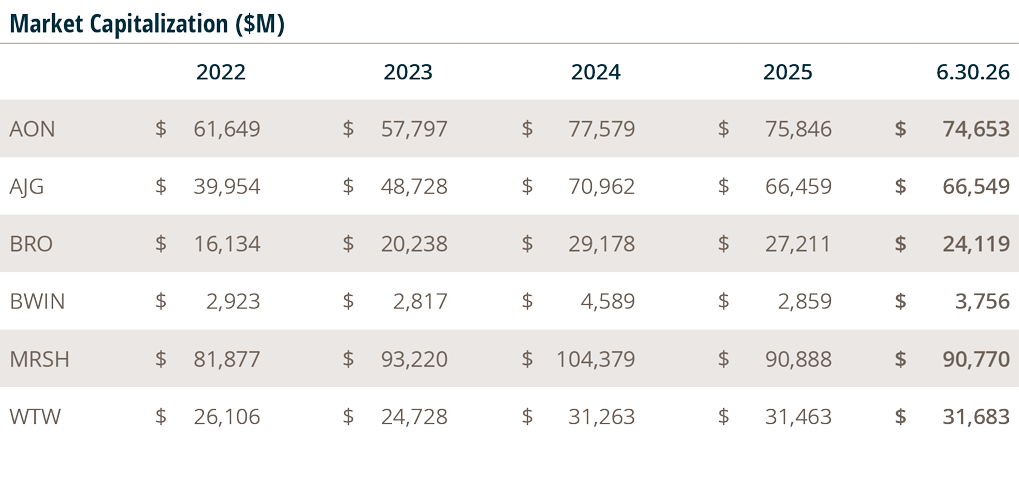
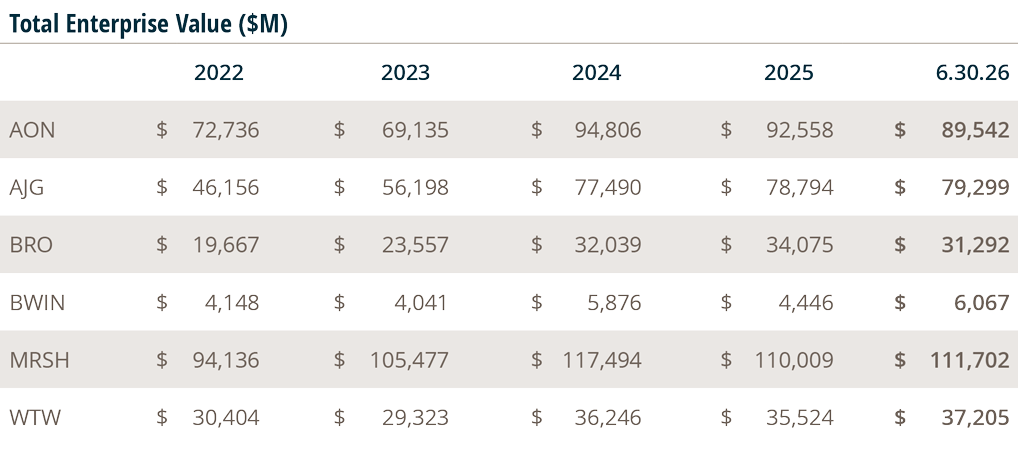
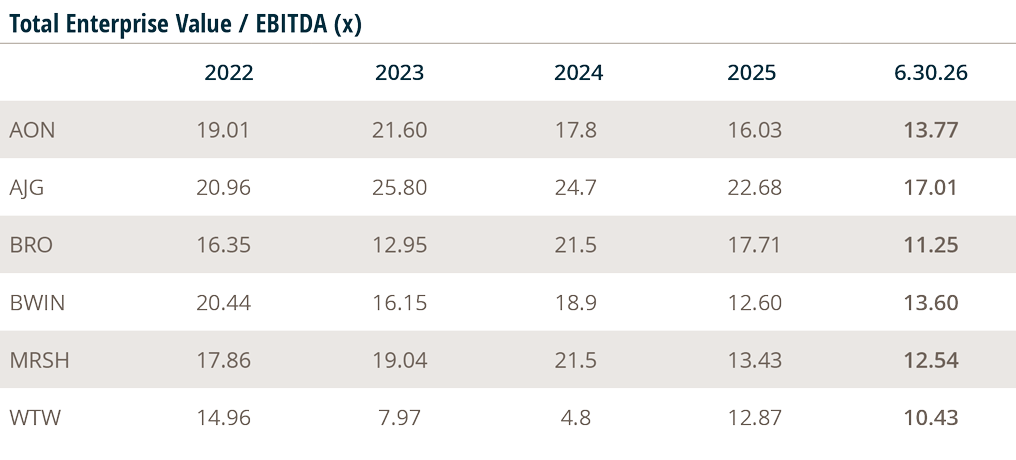
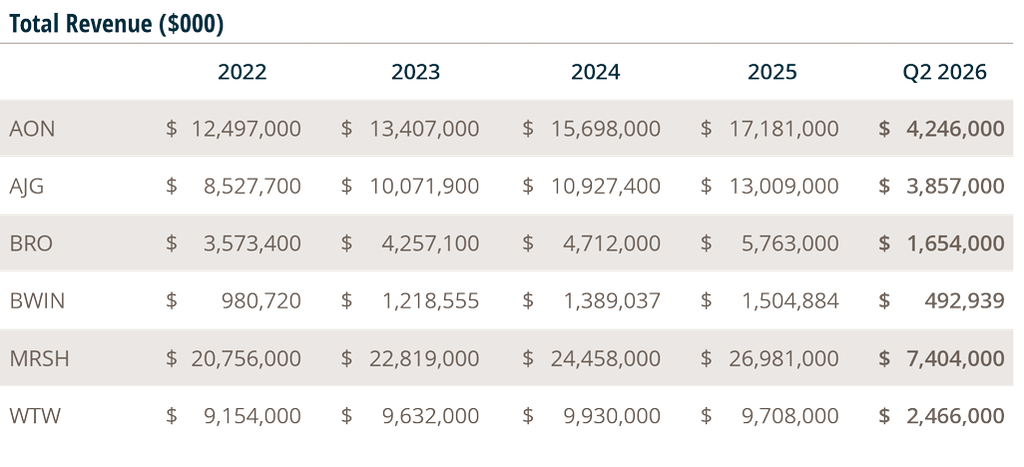
Public Broker Comps
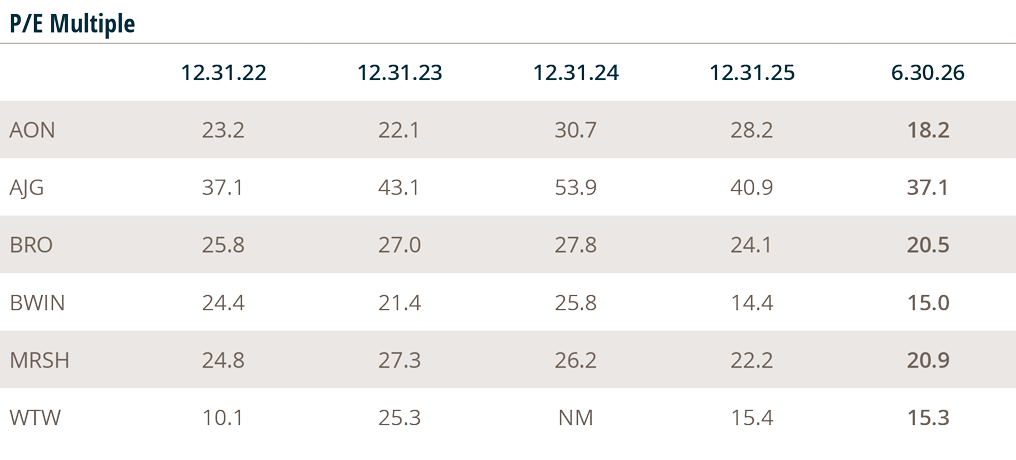
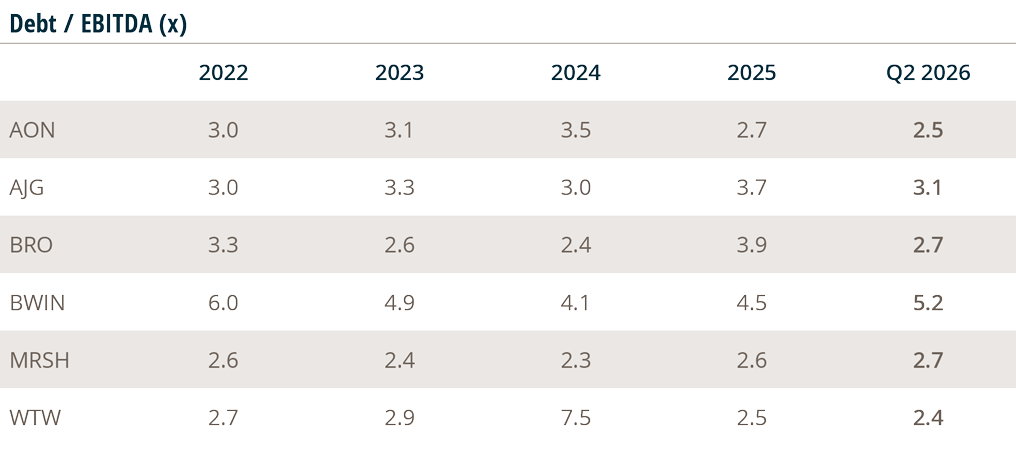
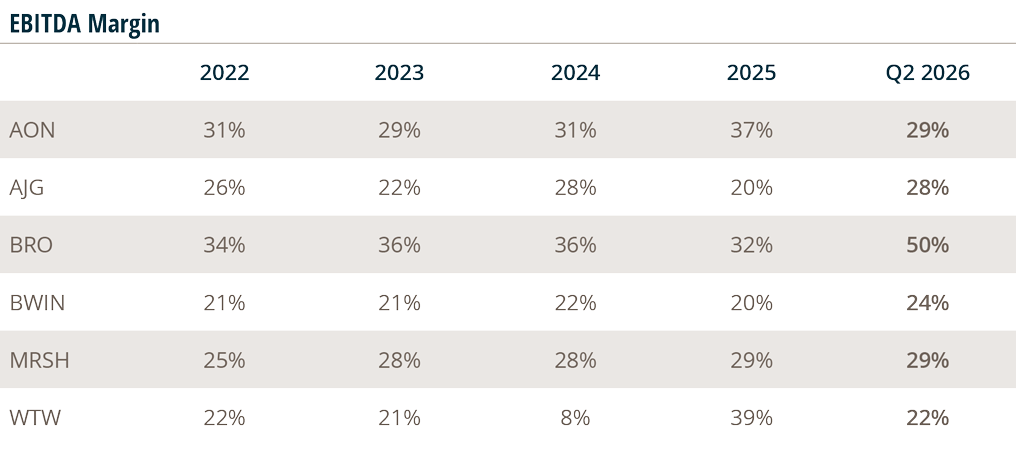
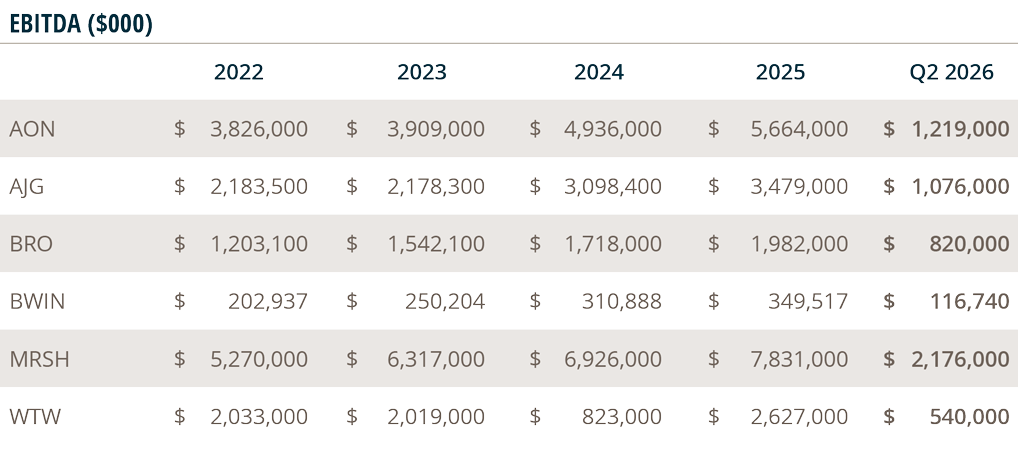
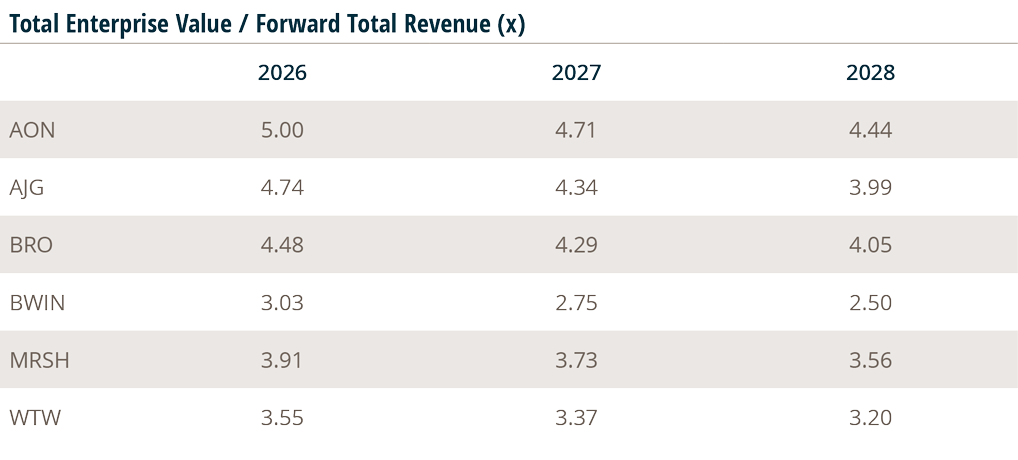
Sources: S&P Global, Company Reports, accessed 08.21.2026


