
Two narratives are shaping the U.S. economy, and they appear to be moving in opposite directions. Financial markets are signaling confidence as the equity markets remain near record highs, driven by resilient corporate earnings and optimism surrounding AI, and the potential easing of inflation. At the same time, consumer confidence has been weak, with survey data from the University of Michigan revealing caution and pessimism among many Americans.
U.S. consumer sentiment reached a record low in May 2026, but improved slightly through June. Overall, it’s been a downward-trajectory since the end of 2024. While this divergence appears unusual, it may mean that investors and consumers are focusing on different aspects of the economy. Financial markets are inherently forward-looking and are currently displaying optimism by investors. Consumers tend to focus on the present and are showing increased pessimism with the current economy.
Markets are pricing in future productivity
Consumers feel stretched, but spending is holding up
Consumers, meanwhile, are feeling the impact from rising costs. Although inflation has eased from its 2022 highs, prices remain well above pre-pandemic levels, and the recent increase in gasoline prices following the conflict in Iran has added to household pressure. Rising costs for groceries, housing, fuel, and household goods continue to weigh heavily on consumers, even as broader economic indicators have improved. From a consumer perspective, economic growth doesn’t matter as much to them as balancing income with expenses. Furthermore, over 25% of working-age adults who used credit cards to buy groceries had repayment challenges, according to a survey published in July by the Urban Institute.1
On the other hand, consumer spending has remained surprisingly resilient even as confidence has weakened. Recent gross domestic product (GDP) data showed real consumer spending growing at a solid pace, helping support economic growth despite persistent concerns about inflation and affordability. In other words, consumers are still spending, but not with optimism.
Stock ownership is highly concentrated
Another contributor to the disconnect is the uneven distribution of investment ownership. While many Americans have some exposure to equities through retirement accounts, stock ownership remains concentrated among higher-income households. According to Gallup, 58% of U.S. adults owned stock as of April 2026; however, a 2025 Federal Reserve survey found that only 37% held stocks or investment funds outside retirement accounts. As equity markets appreciate, the wealth effect primarily benefits investors with substantial financial assets, while households with limited market exposure experience little direct improvement in their financial position.
Interestingly, even affluent households have become more cautious. University of Michigan data indicates that consumers with significant stock holdings remain more optimistic than the general population but continue to report historically weak sentiment. This suggests that broader concerns, including geopolitical uncertainty, elevated living costs, and questions surrounding future employment, are influencing confidence across income levels.
The impact of AI on stock market performance and consumer confidence
AI continues to shape the current market environment, contributing to a widening gap between equity market performance and consumer sentiment. Investors are optimistic on the long-term earnings potential of AI-driven innovation, while consumers may be concerned about potential job losses and workplace shifts due to AI.
For business leaders, the key question is whether AI investments produce measurable gains without undermining demand or creating unnecessary workforce disruption. Productivity improvements will have limited value if financially strained consumers pull back on spending or employees are unprepared for how their roles will change.
Who can predict a future recession?
History offers no consistent answer. Of the five periods examined, two were followed by recessions, while three were not. The distinction appears to lie partly between consumer sentiment and consumer behavior: weak sentiment alone did not consistently signal a downturn, but in 2000 and 2007, deteriorating consumer spending and broader economic fundamentals preceded recessions. Today’s divergence should therefore be viewed as a risk indicator – not a reliable recession forecast.
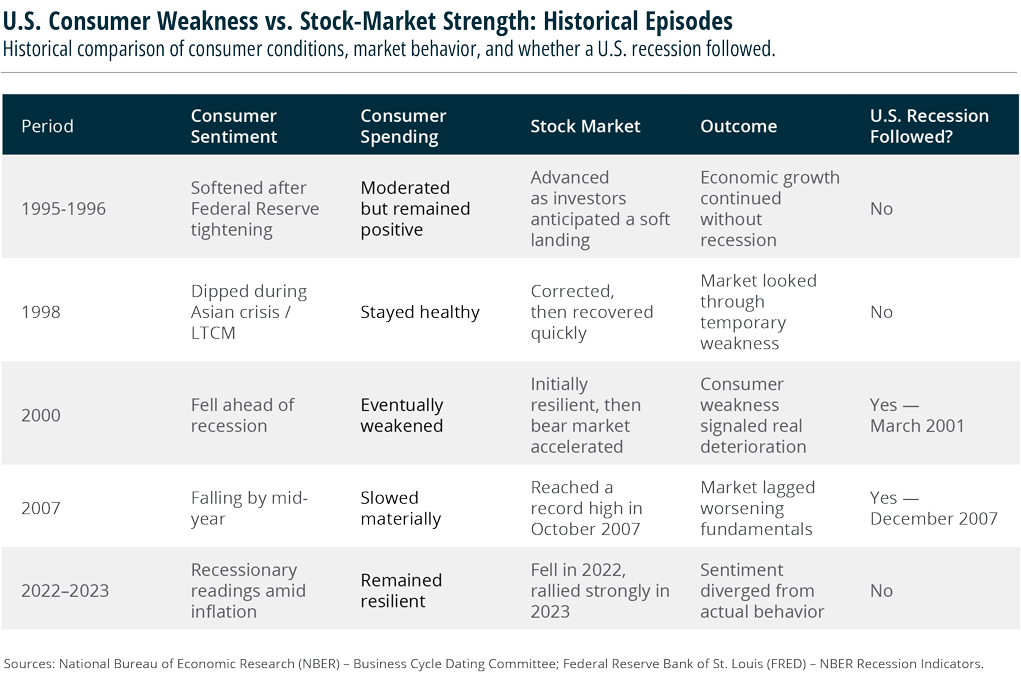
The current environment reflects two competing narratives. Markets continue to price in a future characterized by stronger productivity, accelerating AI adoption, and sustained earnings growth. Consumers remain focused on the realities of elevated living costs and uncertainty about how AI may reshape employment and job security. However, because the U.S. economy is strongly dependent on consumer spending, tracking whether softer sentiment is impacting spending could offer insight into future economic growth.
Eventually, one narrative is likely to move closer to the other. Either improving household fundamentals will validate stock market optimism, or stock market expectations will adjust to consumer sentiment and reflect a more cautious economic outlook. Until then, the gap between Wall Street and Main Street will remain one closely watched indicator of the broader U.S. economy.
Contributions to this article by: Dani Zhelezova, MarshBerry Vice President, Business Intelligence
Source:
1. https://www.urban.org/research/publication/many-families-rely-credit-and-savings-afford-groceries


