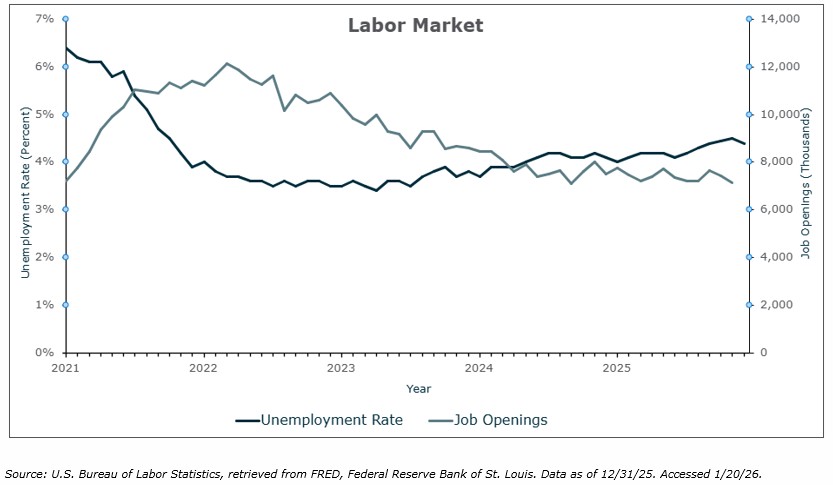
The job market has been strong over the last two years, with resilient growth and low unemployment, further intensifying competition for talent in the insurance brokerage sector. However, recent data indicates signs of slowing: December 2025 job openings fell to levels not seen since September 2020 and revised BLS (Bureau of Labor Statistics) data showed nearly zero job growth in 2025.1
Talent acquisition and retention have long been competitive in the insurance brokerage industry, which has faced issues such as the high number of experienced insurance professionals projected to retire over the next few years, and the difficulties in attracting younger talent. Against the backdrop of uncertainty and potential softening in the broader labor market, this may be a good time for firms to be proactive and evaluate their talent strategies, driving growth and productivity.
If the job market continues to be more measured in 2026, it could create an opportunity for firms around talent. Being disciplined and intentional in acquiring great talent is structurally advantageous. A slowdown in competition can open doors to top performers who were previously less accessible. Another potential upside is that a slower hiring market tends to bring compensation more into balance, meaning brokerages can lead with a total value proposition rather than focusing solely on compensation.
Signs of a cooling labor market
The January 2026 jobs report showed that 130,000 jobs were added for the month and the unemployment rate decreased slightly to 4.3% from December’s 4.4%. The headline figures may look positive, but there were also 108,435 job cuts in January at U.S. employers. This was a 118% increase from January 2025 and the highest January total since 2009, according to Challenger, Gray & Christmas.2
In the minutes for its December meeting, the Fed offered evidence of a cooling labor market by citing: a slowdown in the growth of overall employment levels, data around initial claims for unemployment insurance benefits, rates of job openings and layoffs, and survey measures of perceptions of the balance between labor demand and supply.
How to be proactive with workforce planning and hiring
In an uncertain labor environment, strategic enhancements to talent strategies can help improve the hiring and retention of high-performing insurance professionals. Here are five potential solutions for reaching these goals:
1. Align headcount planning with strategic goals
Does your hiring plan align with your overall strategic plan? Having a strategic talent acquisition strategy starts with robust talent management practices and clarity around internal skill gaps, as well as hiring plans that are aligned with growth projections. This will ensure that your firm follows a proactive capacity-based plan to avoid understaffing or limiting profitability.
One critical performance indicator (CPI) for firms to track is their Revenue per Employee, which has risen for the insurance brokerage sector each year since 2015.3 Firms can look to benchmark how they compare to other firms using this metric if they need to actively increase staff efficiency and productivity.
2. Enhance company culture and value proposition
Competitive job seekers today prioritize experiences that contribute to professional growth and a healthy work-life balance, rather than simply attractive amenities. What truly differentiates your company culture? Do you cultivate an environment where asking questions is encouraged and learning is the norm? Do you believe in inclusivity, ensuring all voices are heard and valued? Does your leadership team provide guidance and genuinely invest in others’ successes? Are these included in regular operations? Most workers are open to opportunities with exceptional company cultures. Articulating yours will unlock more doors than anything else.
3. Reassess compensation and benefits
To attract and retain high-performing employees, companies must move beyond solely offering competitive salaries (although that is a perk). A comprehensive compensation strategy now encompasses transparency in pay scales and decision-making processes, fostering trust and a sense of fairness.
Smaller insurance brokers may need to align compensation with national, not local standards. Candidates now consider opportunities beyond their immediate market, including remote roles and positions in other industries. As a result, recruiters need to search for candidates beyond the traditional insurance industry pools.
Non-salary benefits that focus on employee well-being, professional development and sense of purpose are quickly becoming table stakes for attracting the best talent. Flexible work arrangements such as remote work options and compressed workweeks cater to the evolving desire for work-life balance. Most respondents in MarshBerry’s 2025 Compensation Study indicated that they offer remote work opportunities to either all or select employees, provided the role can be done remotely. Additionally, professional development opportunities like conferences, tuition reimbursement, or in-house training programs signal a company’s dedication to employee growth and future potential.
By combining competitive compensation with a focus on well-being, growth, and purpose, companies can craft a modern compensation strategy that attracts and retains top talent in today’s competitive market.
4. Leverage AI in recruiting and prioritizing digitally skilled talent
To attract the passive candidate, integrate AI into your recruiting process. AI-powered tools such as résumé parsing technology, talent pool analysis, and chatbots can all help build pipelines, increase candidate response, and automate time-consuming processes. The right technology will also offer data to improve candidate quality, enhance the candidate experience, and ultimately make more informed and strategic hiring decisions.
According to MarshBerry’s inaugural Technology and Governance Report, AI adoption is a near-term priority with 80% of firms saying that expanding or exploring AI and automation for internal operations is the top technology focus over the next 12-18 months. In terms of current usage, 61% of firms are piloting or using it in limited areas and another 23% plan to explore use cases.
Brokerages are remaining competitive by modernizing workflows, enhancing customer experience, and being resilient in a rapidly evolving market. Digital capabilities — including analytics, automation, and AI-enabled tools — are increasingly important for productivity and growth. Hiring workers with specific digital skills is an important element to include in your talent strategy, as emerging technologies such as machine learning, AI, and analytics are shifting how the industry functions.
Implementing these strategies will help your firm maintain competitiveness and drive growth through the uncertain labor market of 2026 and beyond.